

Employee Welfare Fund (EWF)
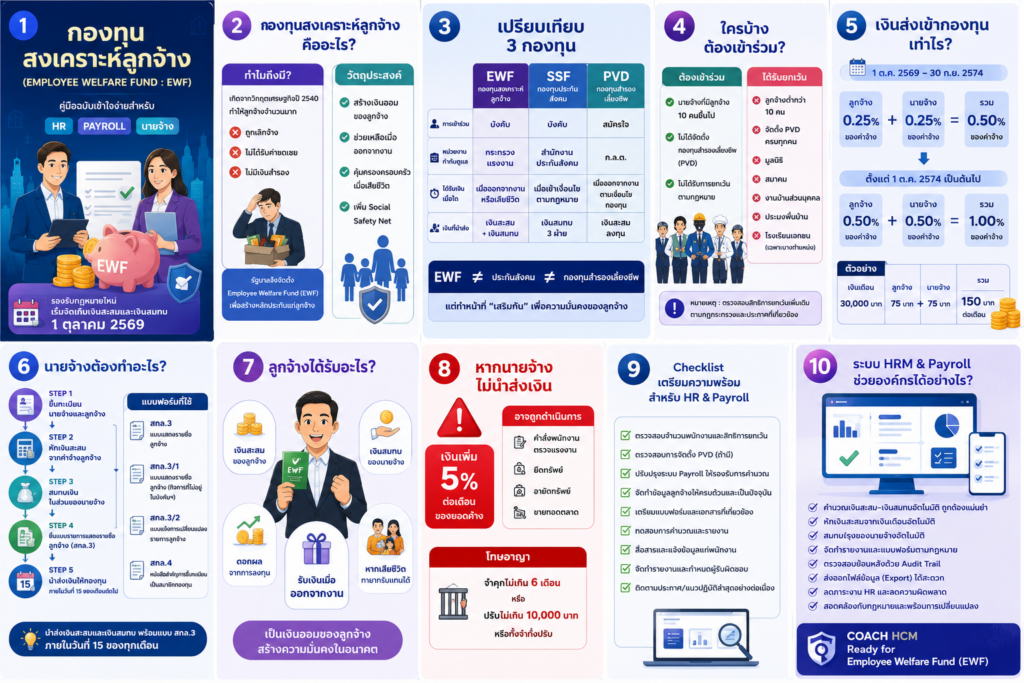
Thailand’s Employee Welfare Fund (EWF) is a statutory fund established under labour law to provide financial protection for employees when their employment ends under conditions specified by law. The regulation is scheduled to take effect on 1 October 2026, making it an important compliance requirement for employers across Thailand.
As the implementation date approaches, employers and HR professionals should begin preparing for employee registration, contribution management, payroll adjustments, and regulatory compliance. Early preparation will help organizations minimize operational risks and ensure a smooth transition once the law comes into effect.
This guide explains everything HR professionals and business owners need to know about Thailand’s Employee Welfare Fund, including eligibility, contribution rates, employee benefits, registration procedures, and practical preparation steps for HR and Payroll teams.
Key Information About the Employee Welfare Fund (EWF)
| Item | Details |
|---|---|
| Effective Date | 1 October 2026 |
| Applicable Parties | Employers and Employees |
| Employee Contribution | 0.25% of wages (First 5 years) |
| Employer Contribution | 0.25% of wages (First 5 years) |
| Governing Authority | Department of Labour Protection and Welfare |
What is the Employee Welfare Fund (EWF)?
Human resource management today is no longer limited to salary administration, employee benefits, or talent development. It also includes compliance with evolving labour laws.
One important topic that HR teams, business owners, and executives should pay close attention to is the Employee Welfare Fund (EWF), which is scheduled to take effect on 1 October 2026.
Many organizations may have heard of the EWF but may still be unsure what it is, why it matters, who must participate, and how employers should prepare. This guide summarizes the key information HR teams and employers should know.
What Is the Purpose of the Employee Welfare Fund?
The Employee Welfare Fund is established under Thailand’s labour protection framework. Its purpose is to provide financial protection for employees and support their financial security when employment ends or when they become entitled to benefits under the law.
The key concept is that both employers and employees contribute to the fund together. This helps employees build financial security for the future, instead of relying solely on severance payments from the employer.
Who Is Involved in the Employee Welfare Fund (EWF)?
Several parties are involved in the operation of the fund:
1. Employees
Employees are members of the fund. They contribute to the fund at the rate prescribed by law and are entitled to receive benefits when the applicable conditions are met.
2. Employers
Employers are responsible for making employer contributions, preparing employee information, complying with relevant procedures, and ensuring that contributions are submitted within the required deadline.
3. Department of Labour Protection and Welfare
The Department of Labour Protection and Welfare supervises the fund, issues relevant rules and regulations, and oversees fund administration in accordance with the law.
Which Establishments Must Participate?
Under the legal criteria, the Employee Welfare Fund applies to establishments governed by the Labour Protection Act.
In the initial phase, the fund is expected to apply to establishments with 10 or more employees. In the future, the scope may be expanded to smaller establishments as required by law.
However, some businesses may be exempt or subject to specific conditions, such as organizations that provide other legally recognized employee welfare arrangements. Employers should closely monitor official announcements from the Department of Labour Protection and Welfare.
What Benefits Will Employees Receive from the Fund?
Once employees become fund members, they may be entitled to benefits under the applicable rules, such as:
- Their own employee contributions
- Employer contributions
- Interest or returns generated from fund management
- Benefits payable upon termination of employment, subject to conditions
- In the event of an employee’s death, benefits may be transferred to eligible beneficiaries as prescribed by law
These benefits are intended to improve employees’ financial security and reduce financial impact when employment ends.
What Are Employee Contributions and Employer Contributions?
Some may misunderstand that the fund is financed only by employers. In fact, the Employee Welfare Fund is based on contributions from both employees and employers at the rates prescribed by law.
The fund consists of:
- Employee contributions
- Employer contributions
- Returns or interest from fund management
When members meet the required conditions, they may apply to receive benefits in accordance with the fund’s rules.
Employee and Employer Contribution Rates
The contribution rates are divided into two phases:
| Period | Employee | Employer |
|---|---|---|
First 5 years | 0.25% of wages | 0.25% of wages |
From year 6 onward | 0.50% of wages | 0.50% of wages |
For example, if an employee earns THB 30,000 per month:
During the first 5 years:
- Employee contribution: THB 75
- Employer contribution: THB 75
Total monthly contribution: THB 150
From year 6 onward:
- Employee contribution: THB 150
- Employer contribution: THB 150
Total monthly contribution: THB 300
How Is the Employee Welfare Fund Different from the Provident Fund (PVD)?
Although both funds aim to support employees’ financial security, they differ in several important areas.
| Topic | Employee Welfare Fund (EWF) | Provident Fund (PVD) |
| Establishment | Required under labour law | Established voluntarily |
| Supervising authority | Department of Labour Protection and Welfare | Securities and Exchange Commission (SEC) |
| Participation | Based on legal criteria | Voluntary participation by employer and employee |
| Purpose | Provides protection when employment ends | Encourages long-term retirement savings |
Organizations should understand the rules of both funds clearly in order to plan employee welfare appropriately.
What Should Employers Prepare When the EWF Takes Effect?
When the Employee Welfare Fund takes effect, employers and HR teams must comply with the required procedures to ensure that contributions and fund administration are handled correctly.
- Register the Employer and Employees
Before contributions begin, employers must register with the Department of Labour Protection and Welfare and prepare complete employee information.
Relevant forms may include SKL.3, SKL.3/1, SKL.3/2, and SKL.4, depending on the case.
- Start Deducting Employee Contributions
Once the law takes effect, employers must deduct employee contributions from wages at the rate prescribed by law. In the initial phase, the rate is 0.25% of wages.
- Allocate Budget for Employer Contributions
In addition to deducting employee contributions, employers must also pay employer contributions at the same rate. In the initial phase, this is 0.25% of wages.
- Submit Contributions and Required Forms on Time
After deducting employee contributions and preparing employer contributions, employers must submit both amounts together with the required employee list form to the local labour protection and welfare office.
Submission must be completed by the 15th day of the following month to comply with the legal deadline and reduce the risk of late submission.
How to Register for the Employee Welfare Fund (EWF)
Checklist for HR and Payroll Before the EWF Takes Effect
Checklist for HR
- Check whether the establishment falls within the legal scope
- Update HR policies
- Review employee handbooks
- Communicate key information to employees
- Prepare complete member information
- Align employee welfare planning with legal requirements
Checklist for Payroll
- Update payroll calculations for employee and employer contributions
- Add employee deduction and employer contribution items to payroll
- Verify data accuracy before submission
- Prepare reports for future audits
- Ensure the system can support future changes in the law
Step 1: Check Whether the Business Falls Within the Legal Scope
Before registration, employers should first determine whether their establishment is subject to the legal requirements.
There are generally two cases:
Case 1: Establishments subject to the law
Employers must register, submit employee and employer contributions, and comply with the required procedures.
Case 2: Establishments not subject to the law
Even if an establishment is not legally required to participate, employers and employees may voluntarily apply to join the fund under the criteria set by the Department of Labour Protection and Welfare.
Step 2: Prepare Required Information and Documents
Employers should prepare complete information before submitting the registration.
Employer information:
- Establishment name
- Company registration number, if applicable
- Tax identification number
- Establishment address
- Authorized signatory
- Telephone number
- Contact email
Employee information:
- Full name
- National identification number
- Employment start date
- Position
- Wages
- Employment status
Step 3: Prepare the Correct Forms
The Department of Labour Protection and Welfare provides forms for registration and information updates, including:
SKL-3
Used as the employee list form for establishments subject to the Labour Protection Act. It is used for registration and member information submission.
SKL-3-1
Used as the employee list form for establishments not subject to the Labour Protection Act, where employees wish to become fund members voluntarily.
SKL.3/2
Used to report changes or corrections to employee list information, such as:
- New employees
- Resigned employees
- Changes to employee information
- Corrections to previously submitted information
This form helps keep fund member records up to date.
Registration Certificate (SKL.4 / SKL.4/1)
Once the documents are reviewed and approved, the authority will issue a registration certificate:
- SKL.4 for establishments subject to the law
- SKL.4/1 for establishments not subject to the law but voluntarily joining the fund
This certificate serves as official evidence of registration as a member of the Employee Welfare Fund.
Step 4: Submit the Registration Application
Employers may submit the application through several channels, including:
- DLPW e-Service system
- Provincial Labour Protection and Welfare Office
- Bangkok Area Labour Protection and Welfare Office
- Postal mail
- Email, depending on the channel specified by the authority
If submitting online, employers may upload the forms and supporting documents directly through the system.
Step 5: Wait for Review and Receive the Registration Certificate
After the application is submitted, officials will review the completeness of the information and documents.
Once approved, the authority will issue the registration certificate and notify the applicant through the registered communication channel.
Step 6: Start Deducting and Submitting Contributions
Once registration is complete, employers must:
- Deduct employee contributions from wages
- Pay employer contributions
- Submit employee and employer contributions to the fund
- Submit the employee list form, such as SKL-3, within the legal deadline
If contributions are not submitted or are submitted late, the employer may be required to pay additional charges as prescribed by law.
Summary
✔ The Employee Welfare Fund (EWF) provide financial protection for employees when employment ends.
✔ It is scheduled to take effect on 1 October 2026.
✔ Employers and employees will jointly contribute to the fund at the rates prescribed by law.
✔ Employers should prepare for registration, HR and Payroll system updates, budgeting, and employee communication.
✔ HRM and Payroll systems that support legal requirements can help reduce errors, improve calculation accuracy, and support compliance.

Frequently Asked Questions about the Employee Welfare Fund (FAQ)
What is the Employee Welfare Fund (EWF)?
The Employee Welfare Fund (EWF) is a statutory fund established under Thailand’s Labour Protection Act to provide financial protection for employees. Employers and employees jointly contribute to the fund at the rates prescribed by law.
Is the Employee Welfare Fund different from the Provident Fund (PVD)?
Yes. The Employee Welfare Fund is a statutory fund under labour law, while the Provident Fund (PVD) is a voluntary employee benefit established jointly by employers and employees.
What should an employer do when hiring a new employee?
Employers should update the employee information and submit the required forms within the timeframe specified by the Department of Labour Protection and Welfare to ensure that the employee’s fund membership information remains accurate.
When can a resigned employee receive money from the Employee Welfare Fund?
A resigned employee may apply to receive employee contributions, employer contributions, and fund benefits when employment ends, subject to the rules and conditions prescribed by law.
What happens if an employer does not submit EWF contributions?
If an employer fails to submit employee or employer contributions within the required deadline, the employer may be required to pay additional charges and may be subject to penalties under the law.
How can HR and Payroll systems support the Employee Welfare Fund?
HR and Payroll systems can help calculate employee and employer contributions, maintain member information, generate reports, and reduce errors in fund administration and compliance.
 Interested in COACH HCM?
COACH HCM helps organizations manage HR, Payroll, Time Attendance, and labour-law-related changes more efficiently.