
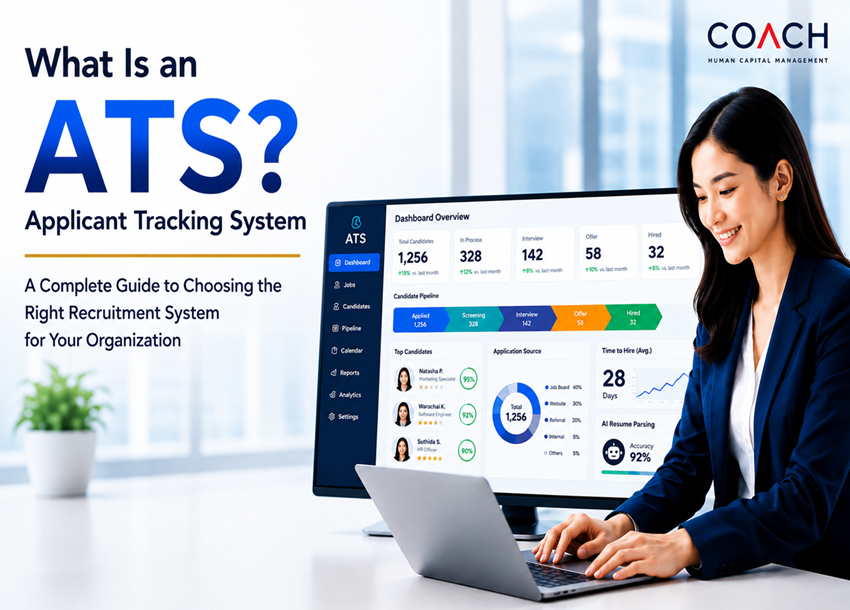
Recruitment today is no longer just about attracting more candidates. Organizations are competing with speed of hiring, accuracy of candidate evaluation, and the overall candidate experience throughout the recruitment journey.
As businesses grow, the number of open positions and job applicants increases significantly. Managing recruitment through emails and Excel spreadsheets alone is no longer sufficient. It often leads to fragmented candidate information, inefficient collaboration between HR and hiring managers, time-consuming reporting, and a higher risk of human error.
This is why an Applicant Tracking System (ATS) has become an essential solution for modern recruitment. An ATS helps organizations streamline the entire hiring process—from job requisition and candidate applications to resume screening, interview management, and job offers. By automating repetitive tasks, improving workflow efficiency, and providing data-driven insights, ATS enables HR teams to make faster and better hiring decisions.
Today, ATS is considered one of the core technologies in modern Talent Acquisition. It empowers organizations to manage recruitment more efficiently while supporting business growth and adapting to the evolving labor market. Recruitment best practices and Talent Acquisition strategies continue to be developed by leading global HR organizations such as the Society for Human Resource Management (SHRM)
What Is an Applicant Tracking System (ATS)?
An Applicant Tracking System (ATS) is recruitment software designed to manage the entire hiring process—from creating job openings and collecting applications to storing candidate information, screening resumes, tracking applicant progress, scheduling interviews, and issuing job offers.
At the core of an ATS is a Centralized Candidate Database, which consolidates all applicant information into a single platform. This allows HR teams and hiring managers to collaborate using the same up-to-date data, reduce duplicate work, and monitor each candidate’s progress throughout the recruitment pipeline.
What Is a Recruitment System and How Is It Related to an ATS?
A recruitment system is software designed to help organizations manage the recruitment and hiring process systematically. It can support the entire process, from creating job openings, receiving applications and resumes, storing candidate information, screening qualifications, tracking candidate status, and scheduling interviews to candidate selection and job offers.
An Applicant Tracking System (ATS) is one of the core systems used to manage these recruitment processes. It centralizes candidate information in a single database, allowing HR teams, recruiters, and hiring managers to track candidates and collaborate efficiently within one system.
Modern recruitment systems may also include advanced capabilities such as Resume Parsing, AI Resume Screening, Candidate Matching, Candidate Pipeline, Interview Management, and Recruitment Analytics to reduce manual tasks and improve recruitment efficiency.
Therefore, for organizations looking for a recruitment system or software to manage their hiring process, an ATS is one of the key solutions to consider—especially for organizations that handle a high volume of applicants, recruit for multiple positions, or involve multiple stakeholders in the candidate selection process.
What Does ATS Stand For?
ATS stands for Applicant Tracking System.
- Applicant refers to a job candidate.
- Tracking refers to monitoring a candidate’s progress through each stage of the recruitment process.
- System refers to the software platform that manages recruitment data and workflows.
Together, an Applicant Tracking System is a software solution that helps organizations manage and track candidates from the initial application through to the final hiring decision.
How Is ATS Different from Traditional Recruitment?
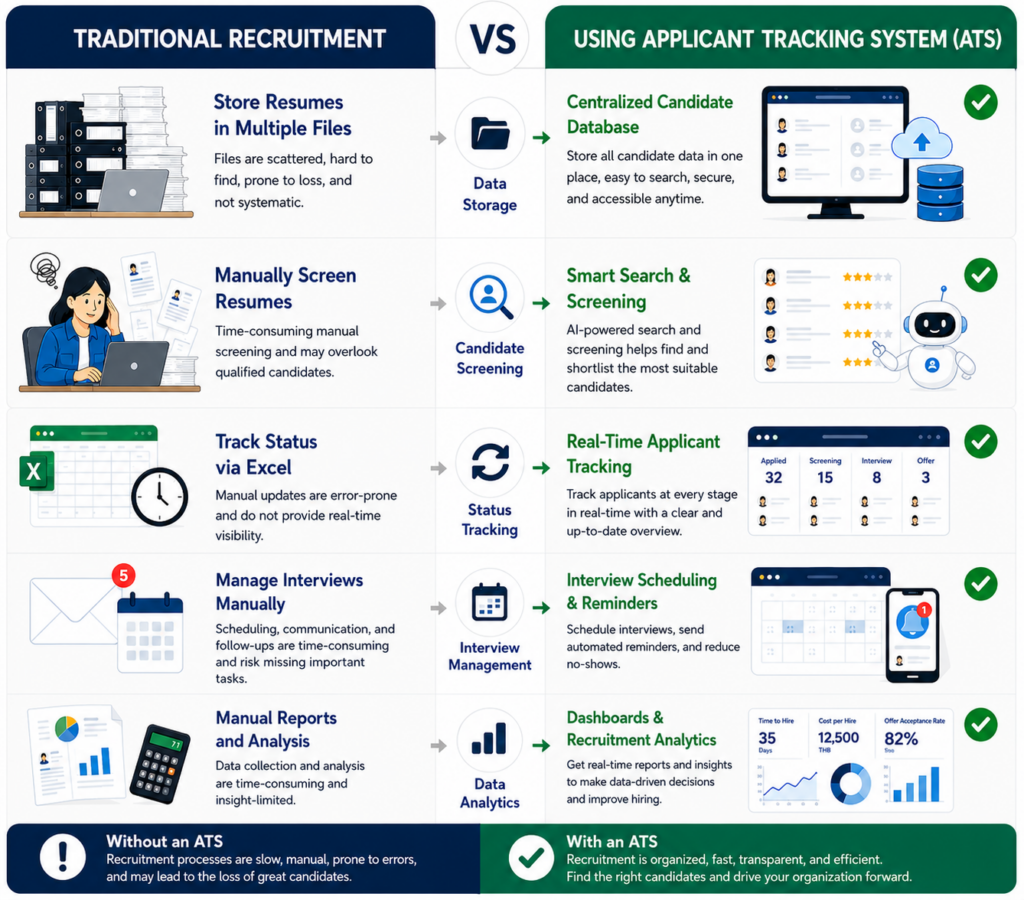
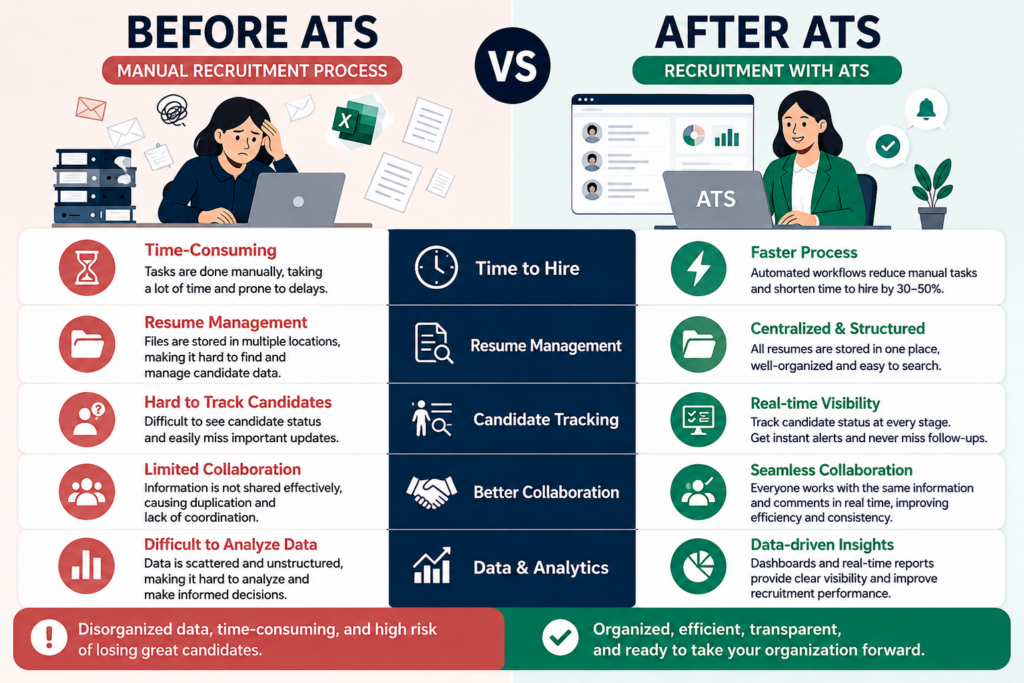
Traditional recruitment often relies on emails, Excel spreadsheets, and multiple documents to manage applicants. As hiring volume grows, this approach can result in scattered information, slow communication, limited visibility into candidate status, and difficulties in tracking recruitment progress.
ATS centralizes the entire recruitment process into a single system. Candidate data becomes standardized, searchable, and easily accessible, while HR teams and hiring managers can collaborate more effectively with real-time visibility into every stage of the hiring pipeline.
Why Are Modern Organizations Adopting Applicant Tracking Systems (ATS)?
Now that you understand what an Applicant Tracking System (ATS) is, the next question is: Why are so many organizations adopting it, and how does it improve the recruitment process?
Today, recruitment is no longer just about posting job vacancies. Successful hiring requires speed, accuracy, and seamless collaboration among HR teams, recruiters, and hiring managers to identify and hire the right candidates before top talent is lost to competitors.
An Applicant Tracking System addresses these challenges by centralizing candidate information and managing every stage of the recruitment process within a single platform. It eliminates repetitive administrative tasks, streamlines collaboration, increases recruitment efficiency, and supports data-driven hiring decisions.
How Does an Applicant Tracking System (ATS) Work?
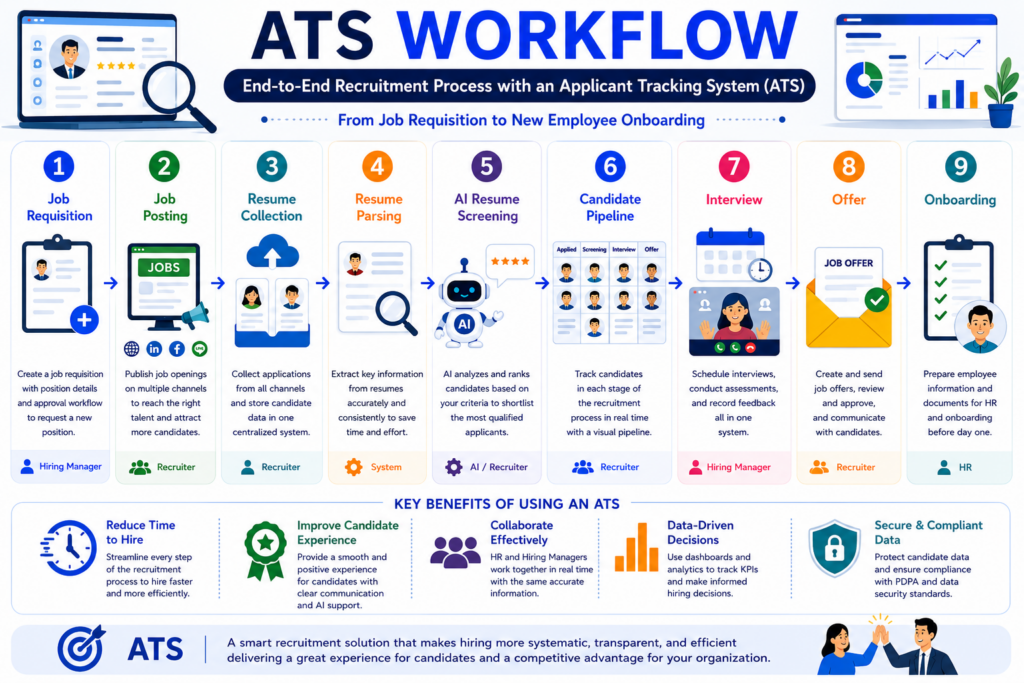
An Applicant Tracking System (ATS) supports the end-to-end recruitment process, managing every stage of hiring—from creating a job requisition to onboarding a new employee—within a unified platform.
Today, many organizations also integrate AI Recruitment with their ATS to analyze resumes, screen candidates, and assist HR teams in making faster, more accurate hiring decisions.
A typical ATS workflow consists of the following key stages:
Job Requisition
The recruitment process begins by creating a job requisition, including the position title, required qualifications, job responsibilities, and hiring requirements. The requisition is then submitted through the organization’s approval workflow before recruitment begins.
Job Posting
Once approved, the ATS publishes the job opening simultaneously across multiple channels, including the company’s career website, online job boards, and other digital recruitment platforms. This helps maximize job visibility while reducing the effort required to post vacancies manually.
Resume Collection and Resume Parsing
Applications from various recruitment channels are automatically collected into a centralized candidate database. Resume Parsing technology extracts and organizes candidate information into a standardized format, making it easier to search, filter, and compare applicants.
AI Resume Screening
Many modern ATS platforms incorporate Artificial Intelligence to evaluate resumes against predefined job requirements. AI can rank candidates based on relevant skills, experience, education, and qualifications, enabling recruiters to prioritize the most suitable applicants while reducing manual screening time.
Candidate Pipeline and Interview Management
Recruiters and hiring managers can track every candidate throughout the hiring pipeline, schedule interviews, record interview feedback, collaborate on evaluations, and monitor each applicant’s progress all within a single system. This improves visibility and ensures a consistent recruitment workflow.
Offer Management and Onboarding
After selecting the successful candidate, the ATS facilitates the job offer process and seamlessly transfers candidate information into the onboarding workflow. This enables HR teams to prepare employment documents, complete pre-employment requirements, and ensure a smooth transition from candidate to employee.
Key Features Every Applicant Tracking System (ATS) Should Have
Once you understand how an Applicant Tracking System (ATS) works, the next step is choosing a solution that truly supports your organization’s recruitment needs. The best ATS is not necessarily the one with the most features, but the one that streamlines recruitment workflows, accelerates hiring, and enables data-driven decision-making.
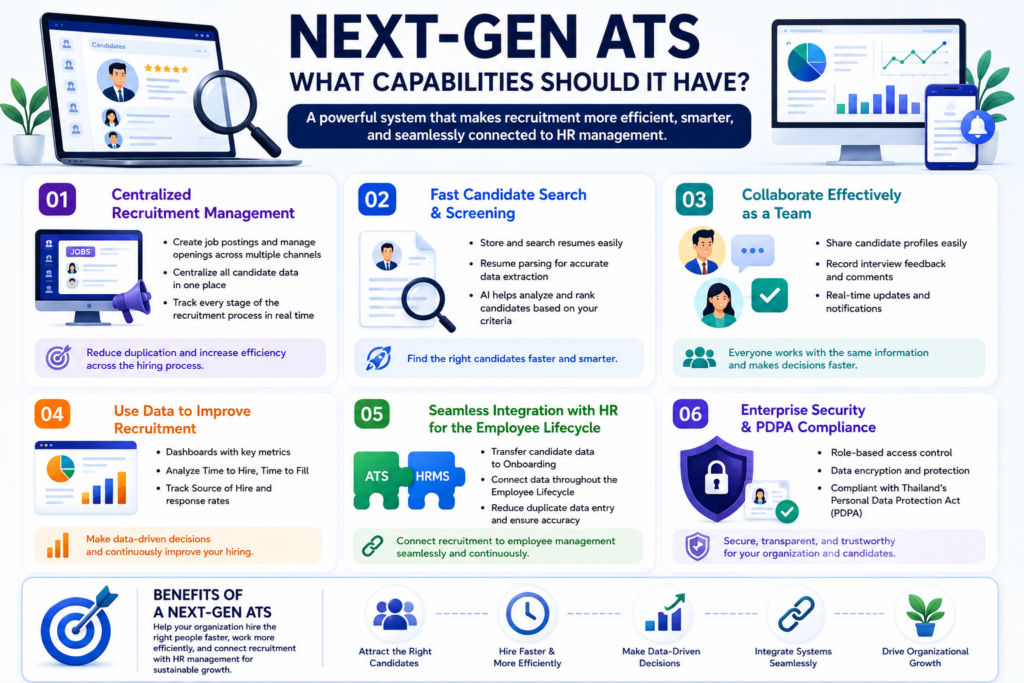
Centralized Recruitment Management
A modern ATS should centralize the entire recruitment process within a single platform—from creating job requisitions and managing candidates to tracking recruitment progress. This enables HR teams and hiring managers to work from the same source of truth, reducing duplicate work and improving recruitment efficiency.
Faster Candidate Search and Screening
An effective ATS should provide a searchable candidate database with structured resume management capabilities. It should also leverage AI to analyze resumes, identify qualified candidates, and prioritize applicants based on predefined job requirements, allowing recruiters to find the best talent more quickly.
Seamless Team Collaboration
Recruitment involves multiple stakeholders, including HR professionals, recruiters, and hiring managers. ATS should enable all parties to track candidate progress, record interview feedback, share evaluations, and collaborate within a single system. This improves communication, speeds up hiring decisions, and creates a more transparent recruitment process.
Recruitment Analytics for Smarter Hiring
Built-in dashboards and Recruitment Analytics help organizations monitor key hiring metrics such as Time to Hire, Time to Fill, and Source of Hire. These insights enable HR teams to optimize recruitment strategies, improve hiring performance, and make more informed workforce planning decisions.
Integration with HR Management Systems
Once a candidate accepts a job offer, their information should seamlessly flow into the onboarding process and employee management system. An ATS that integrates with an HRMS eliminates duplicate data entry and ensures a consistent flow of information throughout the Employee Lifecycle.
As a result, many organizations prioritize recruitment solutions that connect hiring and HR processes within a unified platform. For example, COACH HCM enables seamless data integration between recruitment and broader human resource management functions.
Security and PDPA Compliance
Because an ATS stores sensitive personal information about job applicants, it should provide robust security features such as role-based access control, data encryption, audit logs, and compliance with Thailand’s Personal Data Protection Act (PDPA) . These capabilities help organizations safeguard candidate data, maintain regulatory compliance, and build trust with both applicants and internal stakeholders.
Benefits of an Applicant Tracking System (ATS) for Organizations
Implementing an Applicant Tracking System (ATS) provides far more than an organized way to manage job applicants. It helps organizations optimize the entire recruitment process, reduce administrative workloads for HR teams, and support data-driven hiring decisions.
Below are some of the key benefits organizations can achieve by adopting an ATS.
Reduce Time to Hire
An ATS streamlines every stage of the recruitment process—from job requisition and candidate screening to interviews and job offers. By eliminating manual bottlenecks and improving workflow efficiency, organizations can shorten their hiring cycle and reduce the risk of losing top talent to competitors.
Improve HR Productivity
By centralizing candidate information within a single platform, an ATS minimizes paperwork and repetitive administrative tasks. This allows HR professionals to spend more time on high-value activities such as evaluating candidates, workforce planning, and developing strategic recruitment initiatives.
Enhance Hiring Quality
An ATS helps standardize candidate evaluations by consolidating information from resumes, interview feedback, assessments, and other recruitment data. Many modern systems also leverage AI to assist with initial resume screening and candidate ranking, enabling recruiters to make more accurate and objective hiring decisions.
Deliver a Better Candidate Experience
A structured recruitment process—with timely status updates, interview scheduling, and consistent communication—creates a positive experience for job applicants. This not only improves candidate satisfaction but also strengthens the organization’s employer brand, making it more attractive to future talent.
Leverage Recruitment Data for Continuous Improvement
Integrated dashboards and Recruitment Analytics allow organizations to monitor key recruitment metrics such as Time to Hire, Time to Fill, and Source of Hire. These insights help HR teams continuously optimize recruitment strategies, improve hiring performance, and support long-term workforce planning.
Support Organizational Growth
As businesses expand and recruitment demands increase, ATS enables organizations to maintain consistent hiring standards while efficiently managing larger volumes of job openings and applicants. It also provides seamless integration with HR systems, supporting a connected and scalable HR ecosystem as the organization grows.
What Is the Difference Between an Applicant Tracking System (ATS) and an HRMS?
When organizations begin looking for HR technology, one of the most common questions is: What is the difference between an Applicant Tracking System (ATS) and a Human Resource Management System (HRMS), and do you need both?
Although both systems support HR operations, they serve different purposes and complement each other throughout the employee lifecycle.
What Are the Different Roles of ATS and HRMS?
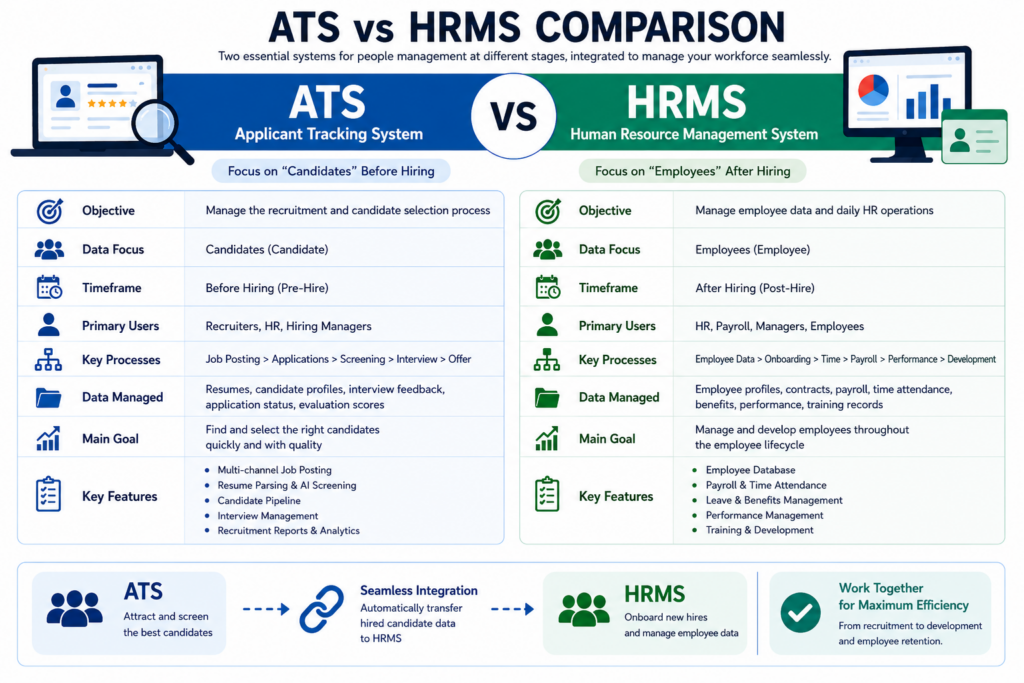
An Applicant Tracking System (ATS) is designed to manage the pre-hire recruitment process. It supports every stage of hiring, including job requisitions, candidate applications, resume screening, interview management, and job offers.
In contrast, a Human Resource Management System (HRMS) focuses on post-hire employee management. It manages employee records, attendance, leave, payroll, performance management, learning and development, and other core HR functions after a candidate becomes an employee.
In simple terms:
- ATS manages candidates.
- HRMS manages employees.
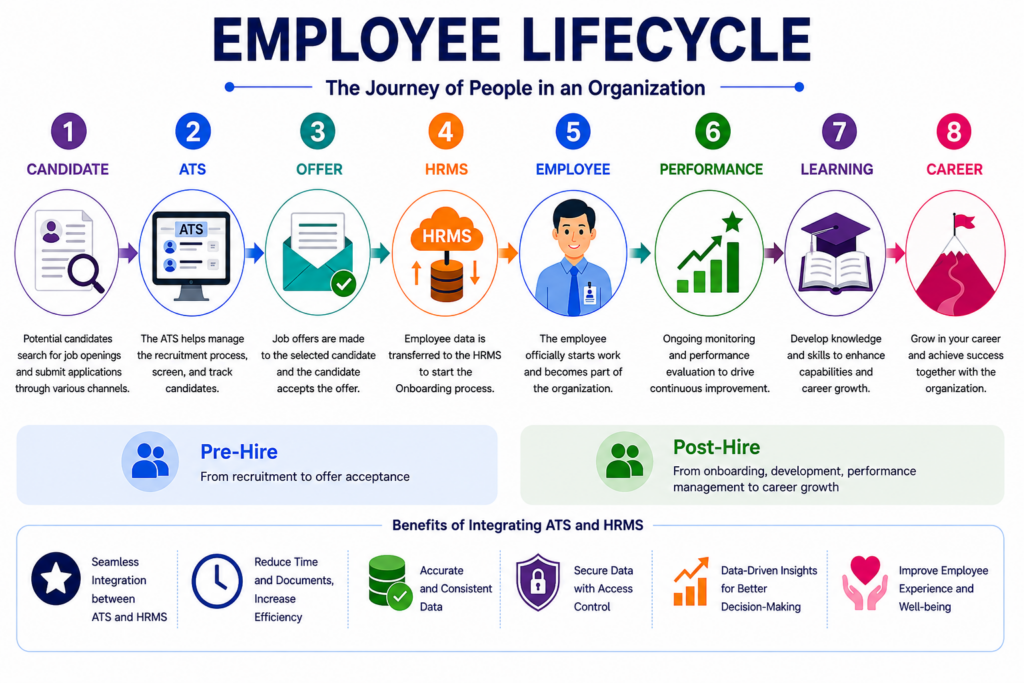
Together, these systems support different stages of the Employee Lifecycle , creating a seamless transition from recruitment to workforce management.
ATS vs. HRMS: A Comparison
To better illustrate the differences, the infographic below summarizes the primary roles, functional scope, and stages of the employee lifecycle where each system adds value—from attracting and hiring candidates to managing and developing employees.
How Do ATS and HRMS Work Together?
Once a candidate accepts a job offer, their information can be transferred automatically from the ATS to the HRMS. This enables a smooth onboarding process without duplicate data entry, improves data accuracy, and ensures a seamless transition from candidate to employee.
For this reason, many organizations choose integrated solutions that connect recruitment and HR management within a single ecosystem. Platforms such as COACH HCM enable continuous data flow throughout the Employee Lifecycle , helping HR teams improve operational efficiency while maintaining accurate employee records.
Which Organizations Should Use an ATS?
An Applicant Tracking System is ideal for organizations that recruit on a regular basis, receive applications from multiple recruitment channels, or involve multiple stakeholders in the hiring process.
As the number of open positions and applicants grows, ATS helps standardize recruitment workflows, reduces the administrative burden on HR teams, improves collaboration among hiring stakeholders, and provides a scalable recruitment process that supports long-term organizational growth.
How to Choose the Right Applicant Tracking System (ATS) for Your Organization
Once you understand how an Applicant Tracking System (ATS) works, its key capabilities, and the benefits it offers, the next step is selecting a solution that best fits your organization’s recruitment needs.
Choosing the right ATS is not about selecting the platform with the most features. Instead, it should be a solution that aligns with your recruitment workflow, is easy for your teams to adopt, and can scale alongside your organization’s long-term growth.
Key Factors to Consider Before Choosing an ATS
Before selecting an ATS, start by evaluating your organization’s current recruitment process, the number of system users, and your future business growth plans.
You should then assess whether the system can:
- Adapt to your recruitment workflows with sufficient flexibility.
- Integrate seamlessly with your existing HR systems.
- Scale as your hiring needs grow.
- Provide reliable implementation services, user training, and ongoing technical support from experienced specialists.
Choosing an ATS that meets both your current and future requirements will help maximize your return on investment while improving recruitment efficiency over the long term.
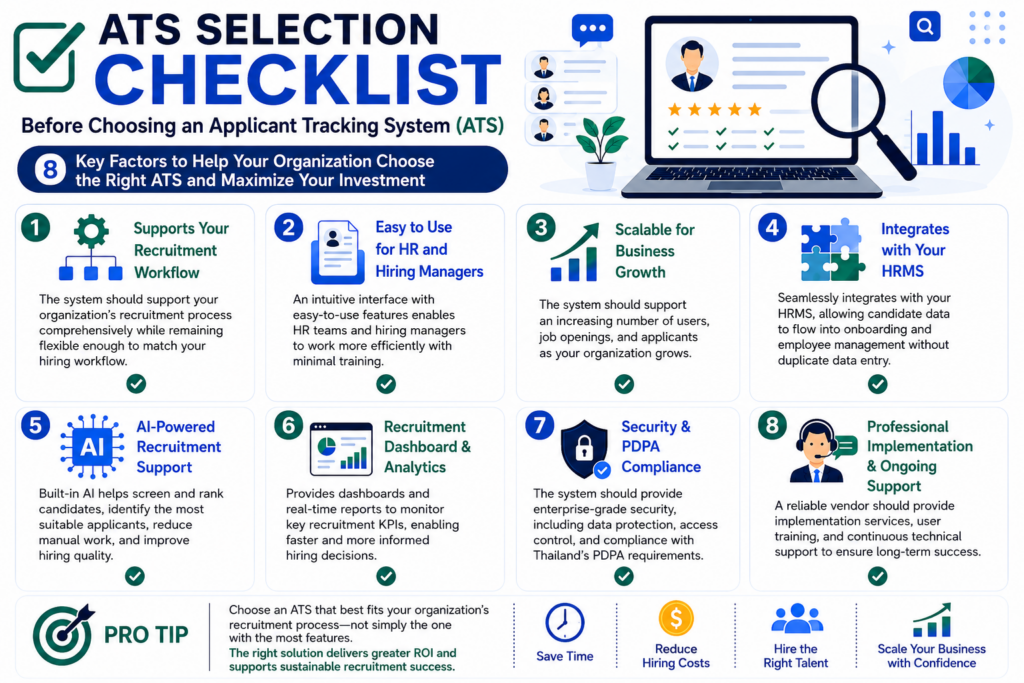
Applicant Tracking System (ATS) Selection Checklist
Before investing in an ATS, use the following checklist to evaluate whether the solution is the right fit for your organization.
- Supports your organization’s recruitment workflow
- Easy for both HR teams and hiring managers to use
- Scalable to support future business growth
- Integrates seamlessly with your HRMS
- Includes AI-powered recruitment capabilities
- Provides dashboards and recruitment analytics
- Meets security standards and PDPA compliance requirements
✅ Backed by professional implementation and ongoing support services
Read Related Articles : AI-Powered HR with AIRA
Read Related Articles : What is HR AI and AI Recruitment? The Beginning of Modern Workforce Management
Conclusion
An Applicant Tracking System (ATS) enables organizations to manage recruitment in a structured, efficient, and scalable way—from creating job openings and screening candidates to hiring and transferring employee information into HR management systems.
Choosing the right ATS can significantly reduce hiring time, improve HR productivity, enhance recruitment quality, and support data-driven decision-making. It also provides a strong foundation for sustainable organizational growth by streamlining recruitment and connecting it with broader HR processes.
Transform Your Recruitment Process with COACH HCM
Choosing the right ATS can simplify recruitment workflows, improve hiring efficiency, and create a seamless connection between talent acquisition and human resource management.
If you are looking for a solution that combines both Applicant Tracking System (ATS) and Human Resource Management System (HRMS) capabilities within a single platform, explore COACH HCM to learn how it can support your recruitment and HR management needs—or request a personalized product demonstration to see the system in action.
Frequently Asked Questions (FAQ) About Applicant Tracking Systems (ATS)
Is ATS suitable for small businesses?
Yes. An Applicant Tracking System (ATS) is beneficial for organizations of all sizes, especially those that recruit on a regular basis. It helps reduce administrative work, organizes candidate information in a structured database, and provides a scalable recruitment process that supports future business growth.
Can an ATS be integrated with an HRMS?
Yes. An ATS manages the pre-hire recruitment process, while an HRMS manages employee information after hiring. The two systems can be integrated to ensure seamless data flow throughout the Employee Lifecycle, eliminating duplicate data entry and improving overall HR efficiency.
Can AI replace HR in candidate selection?
No. AI is designed to assist—not replace—HR professionals. It can analyze resumes, rank candidates, and support initial screening based on predefined criteria. However, final hiring decisions should always be made by HR professionals and hiring managers, taking into account interviews, cultural fit, and other qualitative factors.
How does ATS reduce recruitment time?
An ATS centralizes candidate information, automates repetitive recruitment tasks, and provides real-time visibility into every stage of the hiring process. This enables recruiters and hiring managers to collaborate more efficiently, shorten hiring cycles, and fill open positions more quickly.
What is the difference between ATS and Recruitment Software?
An Applicant Tracking System (ATS) is a specialized solution for managing the recruitment process—from job requisitions and candidate applications to interviews and job offers.
Recruitment Software, on the other hand, is a broader category that may include an ATS alongside other recruitment technologies such as AI Recruitment, Online Assessments, Video Interviewing, and talent acquisition analytics.
In other words, an ATS is one component of Recruitment Software, and many modern recruitment platforms combine these capabilities into a single integrated solution.
 Interested in COACH HCM?