
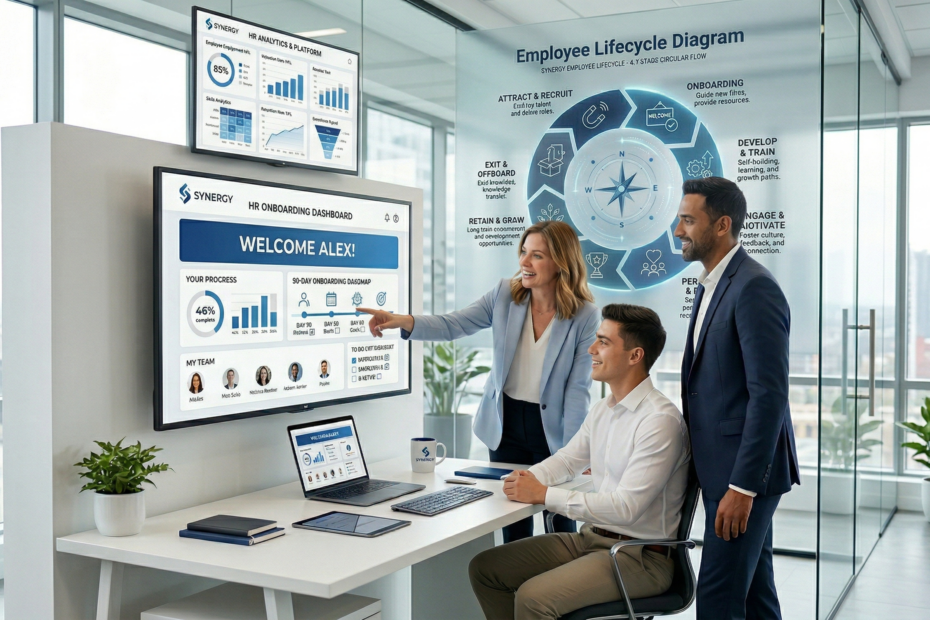
What is Employee Lifecycle Management?
7 Stages to Effectively Manage Employees and Reduce Turnover
“Employees don’t leave companies — they leave poor experiences.”
In today’s competitive talent market, organizations that can attract, develop, and retain top talent gain a significant advantage.
This is why Employee Lifecycle Management (ELM) has become a critical strategy for modern organizations.
It’s not just about managing employees — it’s about designing a meaningful and effective employee experience at every stage.
What is Employee Lifecycle Management?
Employee Lifecycle Management refers to the process of managing an employee’s journey — from the moment they first interact with your organization, throughout their employment, and even after they leave.
The key focus is not just on processes, but on Employee Experience (EX) at every stage.
Organizations that implement ELM effectively can:
- Attract high-quality talent more easily
- Maximize employee potential
- Significantly reduce employee turnover
The 7 Stages of Employee Lifecycle Management
- Attraction – Attract the Right Talent
Organizations need to position themselves as an “employer of choice.”
This includes:
- Building a strong employer brand
- Communicating company culture clearly
- Highlighting benefits such as growth opportunities and work-life balance
👉 The goal is to make top talent want to join your organization.
- Recruitment – Hire the Right People
Effective recruitment is not just about speed — it’s about accuracy.
Best practices include:
- Leveraging HR data (e.g., time-to-hire, quality-of-hire)
- Using structured interviews to reduce bias
- Evaluating both skills and cultural fit
👉 A bad hire can create significant long-term costs.
- Onboarding – Create a Strong First Experience
Onboarding is one of the most critical stages for retention.
A strong onboarding program should include:
- A structured 30-60-90 day plan
- A buddy or mentor system
- Clear goals and expectations
👉 A great onboarding experience increases the likelihood of long-term retention.
- Development – Enable Continuous Growth
Modern employees value growth opportunities as much as compensation.
Organizations should:
- Provide ongoing training and learning programs
- Support upskilling and reskilling
- Establish clear career paths
👉 When employees don’t see a future, they start looking elsewhere.
- Performance – Manage and Measure Effectively
Performance management should not happen once a year.
Organizations should:
- Use KPIs or OKRs aligned with business goals
- Provide continuous, real-time feedback
- Conduct regular 1-on-1 meetings
👉 Employees need clarity on where they stand and how to improve.
- Retention – Keep Your Best Talent
Retention is not about holding people back — it’s about making them want to stay.
Key elements include:
- Employee engagement
- Recognition and appreciation
- Competitive compensation and benefits
👉 Daily employee experience plays a critical role in retention.
- Separation – Manage Exits Professionally
Even when employees leave, they can still create value.
Organizations should:
- Conduct exit interviews
- Analyze reasons for turnover
- Maintain positive relationships
👉 Former employees can become brand advocates or future clients.
Why Employee Lifecycle Management Reduces Turnover
ELM helps organizations understand employees at every stage.
Instead of addressing surface-level issues like salary increases,
ELM focuses on root causes such as:
- Workplace experience
- Career clarity
- Manager relationships
👉 When employees feel valued, they are more likely to stay.
HR Data: A Key Driver for Modern HR
Today’s HR decisions should be driven by data, not assumptions.
Key metrics include:
- Time to Hire
- Turnover Rate
- Engagement Score
- Performance Metrics
👉 Data-driven HR leads to better decision-making and stronger outcomes.
How to Start Employee Lifecycle Management
If your organization is just getting started, follow these steps:
Step 1: Assess Your Current Processes
Identify gaps across each stage of the lifecycle
Step 2: Identify Pain Points
For example:
- High turnover during probation
- Low employee engagement
Step 3: Focus on High-Impact Areas
Start with:
- Onboarding
- Retention
👉 These stages have the most direct impact on turnover.
Conclusion: Employee Lifecycle is a Strategic Advantage
Employee Lifecycle Management is not just an HR function —
it is a business strategy.
Organizations that implement it effectively can:
- Retain top talent
- Improve productivity
- Achieve sustainable growth
Q&A: Effective Employee Onboarding
Q: What is onboarding?
A: Onboarding is the process of helping new employees adapt to their role, team, and company culture. It goes beyond the first day and continues over time (e.g., 30-60-90 days).
Q: Why is onboarding important?
A: It reduces early turnover, improves productivity, and builds engagement from day one.
Q: What is the difference between onboarding and orientation?
A: Orientation is typically a one-day introduction, while onboarding is a long-term process that ensures employees can perform effectively.
Q: How long should onboarding last?
A: A structured 30-60-90 day plan is recommended to support gradual adaptation and performance.
Q: Why do employees leave during probation?
A: Common reasons include lack of structure, unclear expectations, insufficient support, and cultural misalignment.
Q: How can onboarding be improved?
A: Use structured plans, assign mentors, define KPIs, and provide continuous feedback.
Elevate Your HR with the Right System
To effectively manage the entire employee lifecycle, organizations should leverage HR software or HR online systems that enable:
- Structured onboarding processes
- Real-time performance tracking
- Data-driven HR decision-making