
What is HR Data? It's crucial information executives need to know for accurate planning and decision-making.
What is HR data? This is a crucial question that modern executives need to understand in order to make accurate planning and decision-making.
Imagine that…
The executives had to make crucial organizational decisions, but had no information other than “feelings.”
Sounds risky, doesn’t it?
In reality, many organizations still manage “people” in that way.
In reality, HR data can reveal almost everything about an organization.
Regardless of whether
- Why are people quitting?
- Which team has low productivity?
- Or is the organization bearing too high a workforce cost?
The question is…
👉 What types of HR data are there, and what do managers really need to know ?
Examples of using HR data in an organization.
For example,
- Analyze turnover to identify the reasons for employee resignations.
- Use performance data to evaluate the team.
- Analyze payroll to reduce costs.
👉 Using HR Data correctly
We can transform “data” into “accurate decision-making.”
What is HR data? Why do executives need to understand it?
What is HR Data ?
HR data refers to all information related to employees within an organization, such as personal data, salaries, time of employment, performance evaluations, and resignations.
But what makes HR data valuable?
It’s not just about “data collection.”
But it’s about “application”.
When analyzed, it is called…
👉 HR Analytics (People Analytics)
📌 Read more:
👉 [What is HR Analytics and how can it help businesses?]
👉 This helps managers:
- Identify problems before they occur.
- Planning becomes more precise.
- Make decisions based on factual information.
What is HR Data, and what information should executives know? This article highlights 7 key HR data points, such as turnover, payroll, and performance, that can help with more accurate strategic planning and decision-making. Specifically, it explains what HR Data is and how it can help improve data understanding.
What types of HR data are there? (7 pieces of information executives need to know)
HR data can be categorized into four main groups based on the level of usage by executives.
1. Workforce Overview
- Headcount & Workforce Structure
Employee data and organizational structure are the starting point for all planning.
👉 Used for:
- Workforce planning.
- Control costs
- Employee Turnover Rate
After knowing the number of employees, the next important thing is…
👉 “Is your organization losing people?”
👉 Insight:
High turnover often reflects internal problems within the organization.
2. Work Behavior
- Time Attendance
Time-in and time-out data provides insight into actual work patterns.
📌 Read more:
👉 [What is Time Attendance and how can it help organizations?]
- Absenteeism Rate
Leave data reflects employee engagement.
3. Labor Costs
- Payroll & Labor Cost
Personnel costs are a major expense for organizations.
📌 Read more:
👉 [What is payroll and what are its components?]
👉 Used for:
- Control the budget.
- Profit planning
4. Results and Future (Performance & Growth)
- Employee Performance
KPI data and performance results.
📌 Read more:
👉 [What are some HR KPIs that organizations should track?]
- Training & Skill Development
Information on employee development and skills.
👉 Used for:
- Upskill / Reskill
Planning the future of the organization.
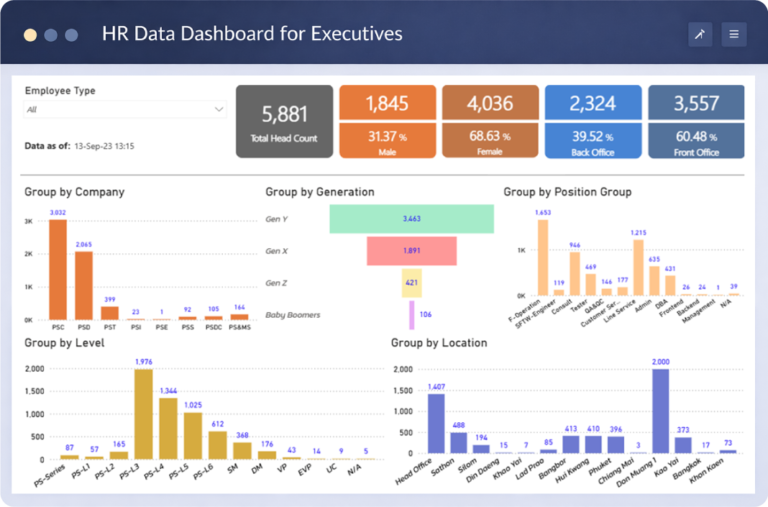
What is an HR Dashboard? Why do organizations need one?
Many organizations have HR data, but it’s “not actually usable” because:
- The data is scattered.
- It’s in Excel.
- I’m late submitting the report.
👉 The solution is the HR Dashboard.
An HR Dashboard is a tool that integrates HR data and displays it in real-time.
📌 Read more:
👉 [What is an HR Dashboard and what should it include?]
👉 Helps with:
- See the big picture immediately.
- Make decisions faster.
- Reduce manual work.
What is HR software? Why is it necessary?
Having HR data alone is not enough.
But there needs to be a “system” to help manage the data.
👉 HR Software or HR System is a system that helps:
- Bringing all HR information together in one place.
- Link Payroll / Attendance / Performance
- Generate automated reports.
📌 Read more:
👉 [What is HR Software and how to choose one?]
Summary of HR Data for Executives
Ultimately, what exactly is HR data? It may not just be a basic question for HR departments.
But it is something that “every executive should understand.”
Because HR Data is more than just “HR information”.
But it is a “crucial tool for executives” in strategic planning and decision-making.
Organizations that can use HR data effectively.
👉 Will be able to:
- Workforce planning can be done more accurately.
- Better control over personnel costs.
- And improve team performance.
In addition, HR data helps executives:
- Able to quickly identify problems within the organization.
- Analyze future trends.
- And they can make decisions based on factual information.
And in the present era.
Having information alone may not be enough.
👉 But we need the “tools” to make that data practically usable.
Which includes HR Software and HR Dashboard.
It helps to consolidate data from all systems into one place and display it in real-time.
👉 Make HR Data more than just “data”.
But it became a “driving force for the organization.”
Frequently Asked Questions about HR Data (FAQ)
How do executives use HR data to make decisions?
Executives can use HR data to analyze organizational situations such as turnover rates, employee performance, and personnel costs, to help develop more accurate strategic plans and make more informed decisions.
What employee data needs to be collected?
Employee data that should be collected includes personal information, work history, salary, time in and out, performance evaluations, and leave information. This is a crucial foundation for HR Data and HR Analytics.
Are HR data important for small organizations?
HR data isn’t just important for large organizations; small businesses can also use HR data to analyze employees, control costs, and plan for growth effectively.
Is it possible to use HR data without HR software?
You can start by storing data in Excel, but in the long run, using HR software will help manage data more accurately, quickly, and reduce errors from manual work.
How can HR data help reduce organizational costs?
HR data helps management see the true costs of employees, such as overtime or hidden expenses, and allows them to use the information to improve management and reduce costs effectively.
Interested in COACH HCM?
If your organization is looking for an HR Management System to manage employee data, payroll, and HR processes more efficiently, our team would be happy to introduce and demonstrate the COACH HCM solution for you.
Request a Demo
https://coachhcm.com/contact/
Tel: +66 2 260 0100