
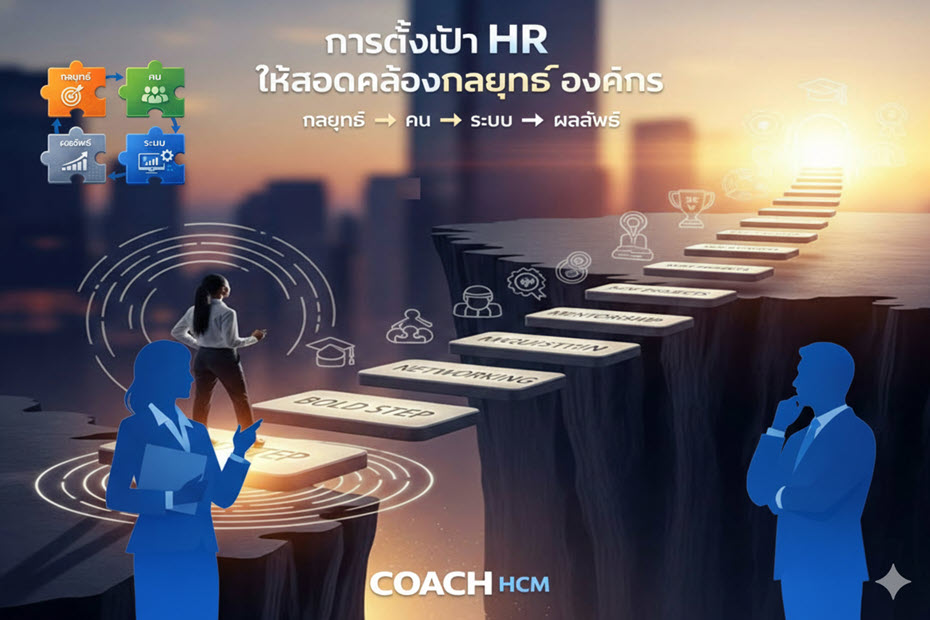
From a Support Function to a True Strategic Partner
In today’s fast-changing business environment,
organizational strategy can no longer be driven by sales, technology, or marketing alone.
People are at the heart of every successful strategy.
The critical question is:
How can HR set goals that go beyond routine operations and become a true driving force behind business success?
This article explores a modern approach to HR goal setting—one that clearly connects
Strategy → People → System → Results in a practical and measurable way.
In 2026, the role of HR has evolved from being a Strategic Partner to becoming a true Strategic Intelligence Provider. HR is no longer responsible solely for translating organizational strategy into people plans; it must now leverage data, technology, and AI to anticipate future workforce needs and support executive decision-making in real time.
As a result, HR goal setting in this era is no longer about defining fixed, annual targets. Instead, it has become a dynamic goal management process—one that continuously adapts to changing business contexts and organizational priorities.
1.Start with Business Strategy, Not Just HR Tasks
Before setting HR goals, HR leaders must clearly understand one thing:
Where is the organization heading?
Common business strategies include:
- Rapid business expansion (Growth Strategy)
- Improving efficiency and cost control (Efficiency Strategy)
- Driving innovation and differentiation (Innovation Strategy)
- Retaining top talent in a competitive market (Talent Retention Strategy)
HR goals will never be effective if HR does not understand the “why” behind the business.
The role of modern HR is no longer limited to executing policies.
HR must actively participate in strategic discussions, analyze business direction, and challenge assumptions alongside leadership.
2. Translate Business Strategy into Measurable HR Objectives
Once the business direction is clear, the next step is transforming strategy into concrete, measurable HR objectives.
Examples of strategy-to-HR alignment:
- Business Growth → Workforce planning to support expansion
- Cost Efficiency → Compensation structure optimization and productivity improvement
- Digital Transformation → Upskilling and reskilling supported by HR technology
- Talent Retention → Enhancing employee experience and clear career paths
A strong HR goal should always answer one key question:
“How does this help the organization achieve its business objectives faster?”
3. Set HR KPIs That Drive Business Impact
Traditional HR KPIs often focus on task completion rather than outcomes.
Strategic HR requires a shift toward business-impact-driven metrics.
Examples of strategic HR KPIs include:
- Reduced time-to-hire to support rapid growth
- Lower turnover rate among high-performing employees
- Increased productivity per employee
- Higher engagement scores leading to stronger performance
Strategic HR KPIs are not just HR metrics—they are business KPIs from a people perspective.
4. Use HR Systems as Enablers, Not Burdens
One of the biggest challenges HR faces today is spending too much time on administrative and repetitive tasks.
To align HR goals with business strategy, organizations need HR systems that enable strategic focus, such as:
- A single, centralized source of employee data
- Real-time people analytics and reporting
- Integrated payroll, time management, performance, and talent management
COACH HCM
is designed as a Center of Integration, connecting all HR data in one platform
so organizations can drive business strategy through accurate, actionable people insights.
5. Review and Adjust HR Goals Regularly
Business strategies evolve—and HR goals must evolve with them.
High-performing organizations typically:
- Review HR goals on a quarterly basis
- Make decisions based on real data, not assumptions
- Adjust HR plans quickly in response to business changes
Great HR is not about rigid planning.
It is about agility, adaptability, and a strong understanding of the bigger picture.
HR Goal Setting in the Age of AI and Data-Driven Organizations
In 2026, leading organizations are beginning to challenge traditional HR planning approaches that rely solely on historical data. Labor market conditions, technology, and employee behavior are evolving faster than annual planning cycles can accommodate.
Modern HR must therefore drive its goals using a real-time and predictive mindset, leveraging People Analytics and AI to answer critical questions such as:
Which skills are likely to become scarce in the next 6–12 months?
Which teams are at risk in terms of engagement or turnover?
Which investments in people development deliver the highest business return?
HR goal setting in the age of AI does not mean replacing the role of HR. Rather, it represents an elevation of the function—from Process Manager to Strategic Decision Designer. HR leaders who can accurately connect people data with business outcomes will become a key driver of sustainable competitive advantage.
This is why HR platforms that function as a Center of Integration are increasingly critical. By consolidating workforce, performance, skills, payroll, and engagement data into a single, unified view, they enable executives and HR teams to set, review, and continuously refine people strategies—keeping pace with business change in every quarter.
Conclusion: HR Goals Are the Bridge Between Strategy and Execution
When HR goals are clearly aligned with business strategy,
HR moves beyond a support role and becomes a strategic partner the organization cannot succeed without.
With the right HR system in place, HR gains the time, focus, and insights needed
to turn strategy into execution—and execution into measurable results.
COACH HCM empowers organizations to align people, systems, and strategy
for sustainable business success.
Q&A: Align HR Goals with Business Strategy
Q1: Why must HR goals align with business strategy?
A:
Because business success ultimately depends on people. When HR goals are disconnected from business strategy, recruitment, development, and retention efforts fail to support organizational priorities, causing strategy execution to slow down or fail altogether.
Q2: How should HR start aligning its goals with business strategy?
A:
HR should begin by deeply understanding the organization’s business strategy—whether it focuses on growth, cost efficiency, digital transformation, or talent retention—and then translate those priorities into clear, measurable HR objectives.
Q3: What are examples of HR goals aligned with business strategy?
A:
Examples include reducing time-to-hire to support rapid growth, increasing productivity per employee for efficiency-focused organizations, and lowering turnover among high performers to strengthen talent retention.
Q4: What makes an HR KPI “strategic”?
A:
A strategic HR KPI reflects business impact rather than task completion. Metrics such as high-performer turnover, engagement scores, productivity per employee, and time-to-hire directly link people performance to business outcomes.
Q5: How do HR systems support strategic HR goal setting?
A:
HR systems reduce administrative workload and provide real-time, integrated people data. This enables HR leaders to analyze trends, make informed decisions, and continuously adjust HR goals in line with business strategy.
Q6: How does COACH HCM help organizations align HR goals with strategy?
A:
COACH HCM acts as a Center of Integration, connecting workforce data, payroll, time management, performance, and talent information into one platform. This holistic view enables HR and executives to set and monitor HR goals that truly support business strategy.
Q7: How often should HR goals be reviewed?
A:
HR goals should be reviewed at least quarterly to remain aligned with evolving business strategies, workforce dynamics, and market conditions. Regular reviews ensure agility and sustained strategic impact.