
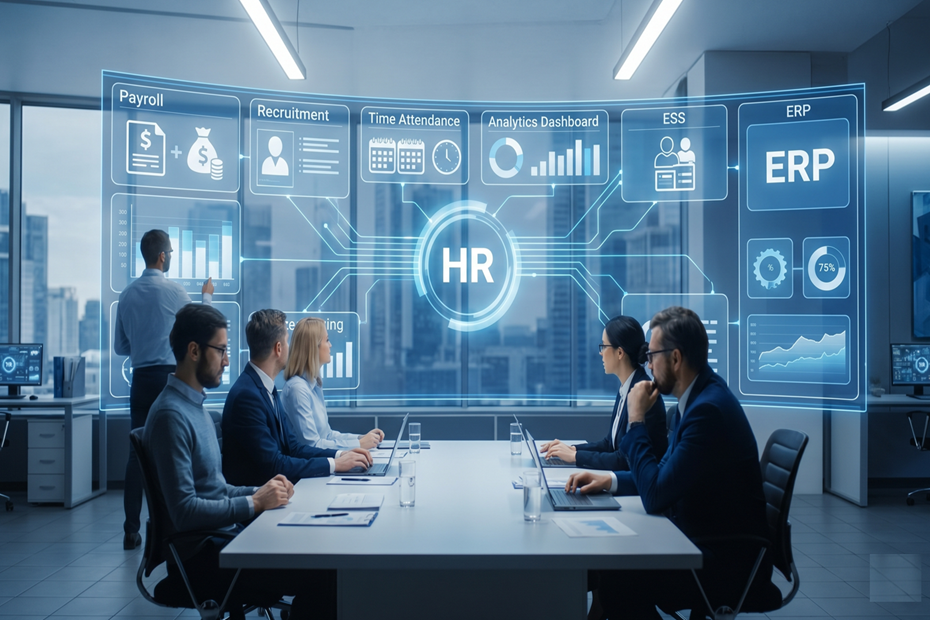
What is HR Center of Integration? Why Modern Organizations Need Connected HR Systems
In 2026, organizations are no longer competing only through products and services.
They are competing through the speed of decision-making and the quality of data.
Companies that can access accurate information faster, identify problems earlier, and make strategic decisions more effectively are more likely to outperform their competitors.
This is especially true in Human Resources (HR), which has evolved far beyond administrative tasks.
Today, HR is expected to play a strategic role in helping organizations grow through data, workforce insights, and business intelligence.
However, many organizations still face the same challenge:
“Disconnected HR data”
Employee information is often spread across multiple systems, such as:
- Payroll systems
- Time Attendance systems
- Recruitment platforms
- Performance management tools
- Training systems
- ERP software
- Accounting systems
- Excel spreadsheets
As a result, organizations experience problems such as:
- Duplicate data entry
- Inconsistent employee records
- Delayed reporting
- Human errors
- Inefficient workflows
- Slow decision-making
This is why modern organizations are shifting toward a new HR approach called:
“HR Center of Integration”
A concept where the HR system becomes the central hub that connects all people-related data across the organization.
What is HR Center of Integration?
HR Center of Integration is a modern HR system approach designed to connect all HR processes and organizational systems into one centralized platform.
Instead of using separate systems that operate independently, all HR-related data is integrated and synchronized automatically.
This includes systems such as:
- Payroll
- Time Attendance
- Recruitment
- Performance Management
- Training
- ESS / MSS
- ERP
- Finance & Accounting
- Approval Workflow
- BI Dashboard
It also connects with external platforms such as:
- Banks
- Social Security systems
- Tax departments
- Job Boards
- E-Signature platforms
- Learning platforms
All information works together seamlessly in real time.
Why Do Modern Organizations Need Connected HR Systems?
1.Reduce Repetitive Work and Human Errors
One of the biggest HR challenges is having to enter the same employee information into multiple systems.
For example, when onboarding a new employee, HR teams may need to manually update:
- Payroll systems
- Attendance systems
- Employee benefits
- Social Security information
- Email accounts
- ERP systems
- Approval workflows
This process is time-consuming and increases the risk of errors such as:
- Incorrect employee information
- Inconsistent salary records
- Wrong department assignments
- Missing approvals
With an integrated HR system:
“Enter data once, and every system updates automatically.”
This significantly reduces manual work while improving accuracy and operational efficiency.
2.Real-Time and Accurate Data
Modern organizations require real-time data to make faster business decisions.
An HR Center of Integration ensures that every update is reflected immediately across all connected systems.
For example:
Employee Leave Request
When an employee submits leave through ESS:
- Managers receive approval notifications instantly
- Attendance records update automatically
- Payroll calculations adjust immediately
- HR dashboards reflect updated leave statistics in real time
Employee Promotion
When an employee receives a promotion:
- Approval authority changes automatically
- Organizational charts update instantly
- Salary structures are adjusted
- ERP and accounting systems receive updated information immediately
This eliminates the common issue of inconsistent data between departments.
3. Better Decision-Making Through Data
Today’s executives need more than basic HR reports.
They need real-time workforce insights to support strategic business decisions.
When HR data is fully connected, management can instantly access information such as:
- Workforce headcount
- Productivity metrics
- Labor costs
- Turnover rates
- Overtime analysis
- Employee performance
- Succession planning
- Employee engagement
For example, if turnover rates increase in a specific department, management can quickly analyze:
- Which teams have the highest resignation rates
- Average employee tenure before resignation
- Salary competitiveness
- Training effectiveness
- Leadership performance
This is the foundation of becoming a:
“Data-Driven Organization”
Where decisions are based on accurate data rather than assumptions or intuition.
4.Support Organizational Growth
As organizations grow, workforce management becomes more complex.
Businesses may expand into:
- Multiple branches
- Multiple subsidiaries
- Multiple countries
- Different policies and regulations
Without an integrated HR system, organizations often face challenges such as:
- Inconsistent HR standards
- Complex approval processes
- Fragmented reporting
- Compliance risks
- Difficult workforce management
An HR Center of Integration helps standardize operations across the organization by centralizing:
- Workflows
- Security controls
- Approval processes
- Policies
- Compliance management
- Reporting systems
This allows organizations to scale more efficiently and sustainably.
What Should a Modern HR System Integrate With?
Internal Systems
- ERP
- Finance & Accounting
- Active Directory
- Email Systems
- Approval Workflow
- BI Dashboard
- Project Management Systems
- Asset Management Systems
External Systems
- Banks
- Social Security Platforms
- Tax Departments
- Job Boards
- Background Check Providers
- E-Signature Platforms
- Learning Platforms
- Government Portals
The more systems an HR platform can integrate with, the more organizations can reduce manual work and improve operational efficiency.
Why HR Center of Integration Matters for Modern HR
In the past, HR was often viewed as a support function.
Today, HR has become a:
“Strategic Business Partner”
Organizations now expect HR teams to:
- Analyze workforce data
- Predict turnover risks
- Plan workforce strategies
- Improve productivity
- Manage talent development
- Build succession plans
These goals are difficult to achieve when HR data remains fragmented across multiple systems.
Integration is no longer optional — it is essential for modern HR transformation.
COACH HCM and the HR Center of Integration Concept
COACH HCM is designed to be more than a traditional HR system.
It is a comprehensive HR platform that helps organizations connect all HR functions within one centralized system.
The platform covers:
- HR Core
- Payroll
- Time Attendance
- ESS / MSS
- Recruitment
- Performance Management
- Training
- Analytics Dashboard
COACH HCM also supports integration with both internal and external systems, helping organizations manage people more effectively in the era of Data-Driven HR.
Conclusion
HR Center of Integration is not just about technology. It represents a new way of managing organizations. A shift from disconnected workflows to fully connected, data-driven operations.
In today’s business world, data is one of the most valuable organizational assets. Modern HR is no longer just responsible for employee administration.
HR must become a strategic partner that helps drive sustainable business growth. And that transformation begins with: “An HR system that connects everything together.”
Q&A : HR Center of Integration
Q1: What is HR Center of Integration?
HR Center of Integration is a concept where the HR system becomes the “central hub” for connecting and managing data across the entire organization. It integrates multiple HR processes and business systems such as Payroll, Time Attendance, Recruitment, ERP, and Accounting into one connected platform with real-time data synchronization.
Q2: How is HR Center of Integration different from a traditional HR system?
Traditional HR systems often focus on only one function, such as payroll or attendance tracking.
An HR Center of Integration, however, connects all HR processes and organizational data together, allowing information to flow automatically across systems. This reduces repetitive work, improves data accuracy, and provides management with a complete real-time overview of the organization.
Q3: Why do modern organizations need integrated HR systems?
Modern organizations rely on speed and accurate data to make effective business decisions.
When HR data is scattered across multiple systems, companies often face issues such as:
- Duplicate data entry
- Inconsistent information
- Delayed reporting
- Human errors
- Inefficient workflows
An integrated HR system solves these challenges by connecting all data into one centralized platform.
Q4: How does an integrated HR system reduce HR workload?
An integrated HR system automates many manual HR processes, such as:
- Entering employee information only once for all systems
- Automatically syncing leave data with payroll
- Updating approval rights instantly after promotions
- Reducing dependency on Excel spreadsheets
This allows HR teams to spend less time on administrative tasks and more time on strategic HR initiatives.
Q5: What systems should an HR platform integrate with?
A modern HR platform should support integration with both internal and external systems.
Internal Systems
- ERP
- Finance & Accounting
- Approval Workflow
- BI Dashboard
- Active Directory
- Email System
External Systems
- Banks
- Social Security
- Tax Department
- Job Boards
- Background Check Services
- E-Signature Platforms
- Learning Platforms
Q6: How does HR Center of Integration help management?
Management teams gain access to real-time organizational insights, including:
- Workforce headcount
- Productivity metrics
- Turnover rates
- Labor costs
- Employee performance
- Succession planning
These insights help executives make faster, more accurate, and data-driven business decisions.
Q7: Do small businesses need an integrated HR system?
Yes. Even small and growing businesses benefit from integrated HR systems.
Starting with a connected HR platform early helps organizations avoid future problems such as fragmented data, inefficient processes, and systems that cannot scale with business growth.
Q8: Can HR Center of Integration support multi-branch or multi-company organizations?
Absolutely.
An integrated HR platform can support multiple branches, subsidiaries, or even multinational operations under one standardized system for workflows, policies, approvals, security, and reporting.
Q9: Why is real-time HR data important?
Real-time HR data allows organizations to respond quickly to changing situations, such as:
- Monitoring absenteeism instantly
- Tracking overtime in real time
- Analyzing turnover trends
- Improving workforce planning accuracy
Real-time visibility helps organizations become more agile and proactive.
Q10: How does COACH HCM support the HR Center of Integration concept?
COACH HCM is designed as a comprehensive HR platform that connects all HR functions within one system.
The platform covers:
- HR Core
- Payroll
- Time Attendance
- ESS / MSS
- Recruitment
- Performance Management
- Training
- Analytics Dashboard
COACH HCM also supports integration with both internal and external systems, helping organizations manage people more effectively in the era of Data-Driven HR.