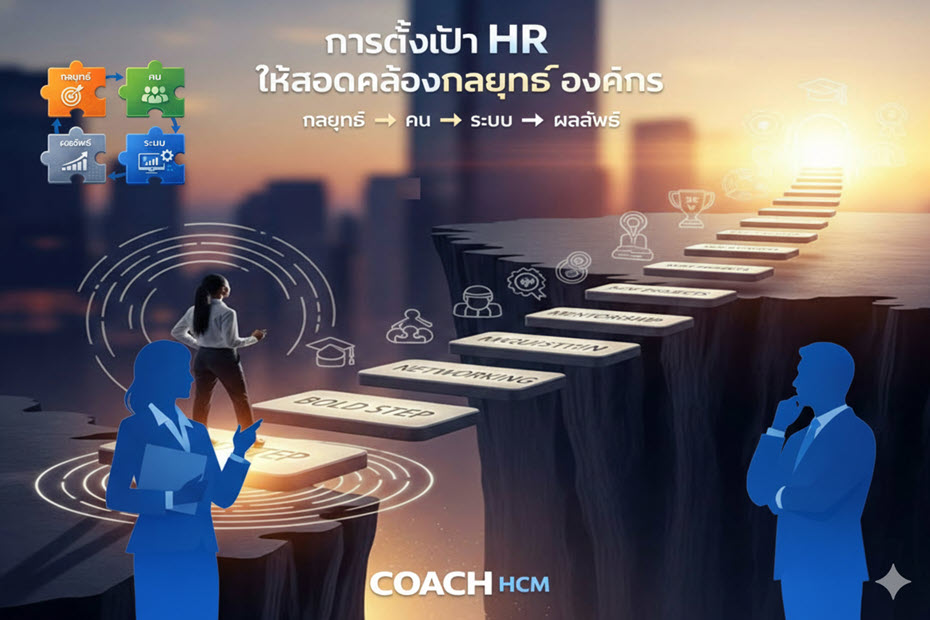
ตั้งเป้า HR ให้สอดคล้องกลยุทธ์องค์กรด้วย KPI และข้อมูลเชิงลึกด้านบุคลากร

กลยุทธ์ HR

ในโลกธุรกิจที่เปลี่ยนแปลงอย่างรวดเร็ว การขับเคลื่อน “กลยุทธ์องค์กร” ไม่อาจพึ่งพาเพียงยอดขาย เทคโนโลยี หรือการตลาดได้อีกต่อไป เพราะ “คน” คือหัวใจสำคัญของทุกแผนงาน

คำถามสำคัญคือ HR จะตั้งเป้าหมายอย่างไร ให้ไม่ใช่แค่การทำงานประจำ แต่กลายเป็นพลังหลักในการผลักดันองค์กรไปข้างหน้า

บทความนี้จะพา HR มองการตั้งเป้าในมุมใหม่ ที่เชื่อมโยง Strategy → People → System → Result อย่างเป็นรูปธรรม

ในปี 2026 บทบาทของ HR ได้เปลี่ยนผ่านจาก Strategic Partner ไปสู่ Strategic Intelligence Provider อย่างแท้จริง HR ไม่ได้มีหน้าที่เพียงแปลงกลยุทธ์องค์กรเป็นแผนงานบุคคล แต่ต้องสามารถใช้ข้อมูล เทคโนโลยี และ AI เพื่อคาดการณ์อนาคตของกำลังคน และสนับสนุนการตัดสินใจของผู้บริหารแบบเรียลไทม์ การตั้งเป้า HR ในยุคนี้จึงไม่ใช่การกำหนดเป้าหมายแบบตายตัวรายปี แต่คือกระบวนการบริหารเป้าหมายที่ปรับเปลี่ยนได้ตามบริบทธุรกิจอย่างต่อเนื่อง

1. เริ่มจากเข้าใจ “กลยุทธ์องค์กร” ไม่ใช่แค่รับโจทย์

ก่อนตั้งเป้า HR ต้องตอบให้ได้ว่า องค์กรกำลังมุ่งไปทางไหน และต้องการเติบโตอย่างไร

ตัวอย่างกลยุทธ์องค์กรที่พบบ่อย เช่น

  • ขยายธุรกิจอย่างรวดเร็ว (Growth Strategy)
  • เพิ่มประสิทธิภาพและควบคุมต้นทุน (Efficiency Strategy)
  • สร้างนวัตกรรมและความแตกต่าง (Innovation Strategy)
  • รักษาและดึงดูดคนเก่งในตลาดที่แข่งขันสูง (Talent Retention)

เป้า HR จะไม่มีวันชัด หาก HR ไม่เข้าใจ “เหตุผล” และ “เป้าหมายเชิงธุรกิจ” ขององค์กร

บทบาทของ HR ยุคใหม่ ไม่ใช่เพียงผู้รับนโยบาย แต่ต้องร่วมคิด วิเคราะห์ และตั้งคำถามเชิงกลยุทธ์กับผู้บริหารอย่างเท่าเทียม

2. แปลงกลยุทธ์องค์กร → เป้าหมาย HR ที่วัดผลได้

เมื่อเข้าใจทิศทางองค์กรแล้ว ขั้นต่อไปคือการแปลงกลยุทธ์ให้เป็น เป้าหมาย HR ที่จับต้องได้และวัดผลได้จริง

ตัวอย่างการเชื่อมโยงกลยุทธ์องค์กรกับเป้าหมาย HR

  • ขยายธุรกิจ → วางแผนกำลังคน (Workforce Planning) รองรับการเติบโต
  • ลดต้นทุน → ปรับโครงสร้างค่าตอบแทน และเพิ่ม Productivity
  • Digital Transformation → Upskill / Reskill พร้อมใช้ HR Technology
  • รักษาคนเก่ง → พัฒนา Employee Experience และ Career Path

เป้า HR ที่ดีต้องตอบคำถามสำคัญให้ได้ว่า “เป้านี้ช่วยให้องค์กรไปถึงเป้าธุรกิจได้เร็วขึ้นอย่างไร”

3. ตั้ง KPI HR ที่เชื่อมกับผลลัพธ์ทางธุรกิจ

หลีกเลี่ยง KPI แบบเดิมที่วัดเพียงว่า “ทำเสร็จหรือยัง” แล้วหันมาโฟกัส ผลลัพธ์ที่ส่งผลต่อธุรกิจโดยตรง

ตัวอย่าง KPI HR เชิงกลยุทธ์ ได้แก่

  • Time to Hire ลดลง → รองรับการเติบโตขององค์กร
  • Turnover Rate ของ Talent ลดลง → รักษาความสามารถหลัก
  • Productivity ต่อพนักงานเพิ่มขึ้น
  • Engagement Score ดีขึ้น → เพิ่มประสิทธิภาพการทำงานโดยรวม

KPI HR ไม่ควรถูกมองเป็นเพียงตัวชี้วัดงานฝ่ายบุคคลแต่คือ Business KPI ในอีกมิติหนึ่ง

4. ใช้ HR System เป็นเครื่องมือ ไม่ใช่ภาระ

อุปสรรคสำคัญของ HR คือ เวลาส่วนใหญ่ถูกใช้ไปกับงานเอกสารและงานซ้ำซ้อน

การตั้งเป้า HR ให้สอดคล้องกลยุทธ์องค์กร จึงต้องมีระบบ HR ที่ช่วยให้ HR โฟกัสงานเชิงกลยุทธ์ได้จริง

เช่น

  • รวมข้อมูลพนักงานไว้ในศูนย์กลางเดียว
  • วิเคราะห์ข้อมูลคนแบบ Real-time
  • เชื่อม Payroll, Time, Performance และ Talent ไว้ในแพลตฟอร์มเดียว

COACH HCM แพลตฟอร์ม HR ที่ออกแบบมาเพื่อเป็น Center of Integration ที่ช่วยให้องค์กรขับเคลื่อนกลยุทธ์ผ่าน “ข้อมูลคน” ได้อย่างมีประสิทธิภาพ

5. ทบทวนเป้า HR อย่างสม่ำเสมอ ไม่ยึดติดแผนเดิม

กลยุทธ์องค์กรไม่เคยหยุดนิ่ง เป้า HR ก็เช่นกัน

องค์กรที่ประสบความสำเร็จมัก

  • ทบทวนเป้า HR เป็นรายไตรมาส
  • ใช้ข้อมูลจริงประกอบการตัดสินใจ
  • ปรับแผนให้สอดคล้องกับสถานการณ์ธุรกิจทันที

HR ที่ดีไม่ใช่ HR ที่ทำตามแผนได้เก่งแต่คือ HR ที่ ปรับตัวเร็ว และมองภาพรวมขององค์กรเป็น

การตั้งเป้า HR ในยุค AI และ Data-Driven Organization

องค์กรชั้นนำในปี 2026 เริ่มตั้งคำถามกับการวางแผน HR แบบเดิม ที่อาศัยข้อมูลย้อนหลังเพียงอย่างเดียว เพราะสภาพตลาดแรงงาน เทคโนโลยี และพฤติกรรมพนักงาน เปลี่ยนแปลงเร็วกว่ารอบการวางแผนประจำปี

HR ยุคใหม่จึงต้องขับเคลื่อนเป้าหมายด้วยแนวคิด Real-time และ Predictive โดยใช้ People Analytics และ AI เข้ามาช่วยตอบคำถามสำคัญ เช่น ทักษะใดกำลังจะขาดแคลนในอีก 6–12 เดือนข้างหน้า ทีมใดมีความเสี่ยงด้าน Engagement หรือ Turnover และการลงทุนด้านการพัฒนาคนรูปแบบใดให้ผลตอบแทนทางธุรกิจสูงสุด

การตั้งเป้า HR ในยุค AI ไม่ได้หมายถึงการแทนที่บทบาทของ HR แต่เป็นการยกระดับบทบาท จากผู้จัดการกระบวนการ (Process Manager) สู่ผู้ออกแบบการตัดสินใจเชิงกลยุทธ์ (Decision Designer) HR ที่สามารถเชื่อมโยงข้อมูลคนกับผลลัพธ์ทางธุรกิจได้อย่างแม่นยำ จะกลายเป็นหนึ่งในกลไกหลักที่ทำให้องค์กรได้เปรียบในการแข่งขันอย่างยั่งยืน

แพลตฟอร์ม HR ที่ทำหน้าที่เป็น Center of Integration จึงมีความสำคัญอย่างยิ่ง เพราะช่วยรวบรวมข้อมูล Workforce, Performance, Skill, Payroll และ Engagement ไว้ในภาพเดียว ทำให้ผู้บริหารและ HR สามารถตั้งเป้า ทบทวน และปรับกลยุทธ์ด้านคน ได้ทันต่อการเปลี่ยนแปลงของธุรกิจในทุกไตรมาส

สรุป

เป้า HR คือสะพานเชื่อม Strategy สู่ Execution

เมื่อ HR ตั้งเป้าหมายที่สอดคล้องกับกลยุทธ์องค์กร HR จะไม่ใช่เพียงฝ่ายสนับสนุน แต่จะกลายเป็น Strategic Partner ที่ผู้บริหารขาดไม่ได้ และเมื่อมี HR System ที่เหมาะสม HR จะมีทั้งเวลา ข้อมูล และโฟกัส ในการขับเคลื่อนองค์กรไปข้างหน้าอย่างยั่งยืน

Q&A ตั้งเป้า HR ให้สอดคล้องกลยุทธ์องค์กร

ทำไมการตั้งเป้า HR ต้องสอดคล้องกับกลยุทธ์องค์กร?


เพราะความสำเร็จของกลยุทธ์องค์กรขึ้นอยู่กับ “คน” หาก HR ตั้งเป้าแยกจากทิศทางธุรกิจ จะทำให้การสรรหา พัฒนา และรักษาพนักงานไม่ตอบโจทย์ ส่งผลให้แผนองค์กรไม่เกิดผลจริง

HR ควรเริ่มจากการเข้าใจ Business Strategy อย่างลึกซึ้ง แล้วแปลงเป็นเป้าหมาย HR ที่ชัดเจน เช่น Workforce Planning, Upskill/Reskill หรือการเพิ่ม Productivity

เช่น ลด Time to Hire สำหรับองค์กรที่เติบโตเร็ว เพิ่ม Productivity สำหรับองค์กรที่เน้นประสิทธิภาพ หรือ ลด Turnover Rate สำหรับองค์กรที่ต้องการรักษาคนเก่ง

คือ KPI ที่สะท้อน Business Impact เช่น Turnover ของ Talent, Engagement Score, Productivity ต่อหัว และระยะเวลาในการบรรจุพนักงาน

HR System ช่วยให้ HR เข้าถึงข้อมูลที่ถูกต้องและเชื่อมโยงกัน ทำให้วางแผน วิเคราะห์ และปรับเป้า HR ได้แม่นยำและรวดเร็ว

COACH HCM เป็น Center of Integration ที่เชื่อมข้อมูล HR ทุกมิติ ช่วยให้ผู้บริหารและ HR มองเห็นภาพรวมข้อมูลคน เพื่อกำหนดเป้า HR ที่สอดคล้องกลยุทธ์องค์กร

แนะนำอย่างน้อยทุกไตรมาส เพื่อให้ทันต่อการเปลี่ยนแปลงของกลยุทธ์องค์กรและสภาพธุรกิจ

เพราะความสำเร็จของกลยุทธ์องค์กรขึ้นอยู่กับ “คน” หาก HR ตั้งเป้าแยกจากทิศทางธุรกิจ จะทำให้การสรรหา พัฒนา และรักษาพนักงานไม่ตอบโจทย์ ส่งผลให้แผนองค์กรไม่เกิดผลจริง

HR ควรเริ่มจากการเข้าใจ Business Strategy อย่างลึกซึ้ง แล้วแปลงเป็นเป้าหมาย HR ที่ชัดเจน เช่น Workforce Planning, Upskill/Reskill หรือการเพิ่ม Productivity

เช่น ลด Time to Hire สำหรับองค์กรที่เติบโตเร็ว เพิ่ม Productivity สำหรับองค์กรที่เน้นประสิทธิภาพ หรือ ลด Turnover Rate สำหรับองค์กรที่ต้องการรักษาคนเก่ง

คือ KPI ที่สะท้อน Business Impact เช่น Turnover ของ Talent, Engagement Score, Productivity ต่อหัว และระยะเวลาในการบรรจุพนักงาน

HR System ช่วยให้ HR เข้าถึงข้อมูลที่ถูกต้องและเชื่อมโยงกัน ทำให้วางแผน วิเคราะห์ และปรับเป้า HR ได้แม่นยำและรวดเร็ว

COACH HCM เป็น Center of Integration ที่เชื่อมข้อมูล HR ทุกมิติ ช่วยให้ผู้บริหารและ HR มองเห็นภาพรวมข้อมูลคน เพื่อกำหนดเป้า HR ที่สอดคล้องกลยุทธ์องค์กร

แนะนำอย่างน้อยทุกไตรมาส เพื่อให้ทันต่อการเปลี่ยนแปลงของกลยุทธ์องค์กรและสภาพธุรกิจ

How to Align HR Goals with Business Strategy Using AI and People Analytics

Align HR Goals with Business Strategy

From a Support Function to a True Strategic Partner

In today’s fast-changing business environment,
organizational strategy can no longer be driven by sales, technology, or marketing alone.

People are at the heart of every successful strategy.

The critical question is:
How can HR set goals that go beyond routine operations and become a true driving force behind business success?

This article explores a modern approach to HR goal setting—one that clearly connects
Strategy → People → System → Results in a practical and measurable way.

In 2026, the role of HR has evolved from being a Strategic Partner to becoming a true Strategic Intelligence Provider. HR is no longer responsible solely for translating organizational strategy into people plans; it must now leverage data, technology, and AI to anticipate future workforce needs and support executive decision-making in real time.

As a result, HR goal setting in this era is no longer about defining fixed, annual targets. Instead, it has become a dynamic goal management process—one that continuously adapts to changing business contexts and organizational priorities.

1.Start with Business Strategy, Not Just HR Tasks

Before setting HR goals, HR leaders must clearly understand one thing:
Where is the organization heading?

Common business strategies include:

  • Rapid business expansion (Growth Strategy)
  • Improving efficiency and cost control (Efficiency Strategy)
  • Driving innovation and differentiation (Innovation Strategy)
  • Retaining top talent in a competitive market (Talent Retention Strategy)

HR goals will never be effective if HR does not understand the “why” behind the business.

The role of modern HR is no longer limited to executing policies.
HR must actively participate in strategic discussions, analyze business direction, and challenge assumptions alongside leadership.

2. Translate Business Strategy into Measurable HR Objectives

Once the business direction is clear, the next step is transforming strategy into concrete, measurable HR objectives.

Examples of strategy-to-HR alignment:

  • Business Growth → Workforce planning to support expansion
  • Cost Efficiency → Compensation structure optimization and productivity improvement
  • Digital Transformation → Upskilling and reskilling supported by HR technology
  • Talent Retention → Enhancing employee experience and clear career paths

A strong HR goal should always answer one key question:
“How does this help the organization achieve its business objectives faster?”

3. Set HR KPIs That Drive Business Impact

Traditional HR KPIs often focus on task completion rather than outcomes.
Strategic HR requires a shift toward business-impact-driven metrics.

Examples of strategic HR KPIs include:

  • Reduced time-to-hire to support rapid growth
  • Lower turnover rate among high-performing employees
  • Increased productivity per employee
  • Higher engagement scores leading to stronger performance

Strategic HR KPIs are not just HR metrics—they are business KPIs from a people perspective.

4. Use HR Systems as Enablers, Not Burdens

One of the biggest challenges HR faces today is spending too much time on administrative and repetitive tasks.

To align HR goals with business strategy, organizations need HR systems that enable strategic focus, such as:

  • A single, centralized source of employee data
  • Real-time people analytics and reporting
  • Integrated payroll, time management, performance, and talent management
COACH HCM
is designed as a Center of Integration, connecting all HR data in one platform
so organizations can drive business strategy through accurate, actionable people insights.

5. Review and Adjust HR Goals Regularly

Business strategies evolve—and HR goals must evolve with them.

High-performing organizations typically:

  • Review HR goals on a quarterly basis
  • Make decisions based on real data, not assumptions
  • Adjust HR plans quickly in response to business changes

Great HR is not about rigid planning.
It is about agility, adaptability, and a strong understanding of the bigger picture.

HR Goal Setting in the Age of AI and Data-Driven Organizations

In 2026, leading organizations are beginning to challenge traditional HR planning approaches that rely solely on historical data. Labor market conditions, technology, and employee behavior are evolving faster than annual planning cycles can accommodate.

Modern HR must therefore drive its goals using a real-time and predictive mindset, leveraging People Analytics and AI to answer critical questions such as:
Which skills are likely to become scarce in the next 6–12 months?
Which teams are at risk in terms of engagement or turnover?
Which investments in people development deliver the highest business return?

HR goal setting in the age of AI does not mean replacing the role of HR. Rather, it represents an elevation of the function—from Process Manager to Strategic Decision Designer. HR leaders who can accurately connect people data with business outcomes will become a key driver of sustainable competitive advantage.

This is why HR platforms that function as a Center of Integration are increasingly critical. By consolidating workforce, performance, skills, payroll, and engagement data into a single, unified view, they enable executives and HR teams to set, review, and continuously refine people strategies—keeping pace with business change in every quarter.

Conclusion: HR Goals Are the Bridge Between Strategy and Execution

When HR goals are clearly aligned with business strategy,
HR moves beyond a support role and becomes a strategic partner the organization cannot succeed without.

With the right HR system in place, HR gains the time, focus, and insights needed
to turn strategy into execution—and execution into measurable results.

COACH HCM empowers organizations to align people, systems, and strategy
for sustainable business success.

Q&A: Align HR Goals with Business Strategy

Q1: Why must HR goals align with business strategy?

A:
Because business success ultimately depends on people. When HR goals are disconnected from business strategy, recruitment, development, and retention efforts fail to support organizational priorities, causing strategy execution to slow down or fail altogether.

Q2: How should HR start aligning its goals with business strategy?

A:
HR should begin by deeply understanding the organization’s business strategy—whether it focuses on growth, cost efficiency, digital transformation, or talent retention—and then translate those priorities into clear, measurable HR objectives.

Q3: What are examples of HR goals aligned with business strategy?

A:
Examples include reducing time-to-hire to support rapid growth, increasing productivity per employee for efficiency-focused organizations, and lowering turnover among high performers to strengthen talent retention.

Q4: What makes an HR KPI “strategic”?

A:
A strategic HR KPI reflects business impact rather than task completion. Metrics such as high-performer turnover, engagement scores, productivity per employee, and time-to-hire directly link people performance to business outcomes.

Q5: How do HR systems support strategic HR goal setting?

A:
HR systems reduce administrative workload and provide real-time, integrated people data. This enables HR leaders to analyze trends, make informed decisions, and continuously adjust HR goals in line with business strategy.

Q6: How does COACH HCM help organizations align HR goals with strategy?

A:
COACH HCM acts as a Center of Integration, connecting workforce data, payroll, time management, performance, and talent information into one platform. This holistic view enables HR and executives to set and monitor HR goals that truly support business strategy.

Q7: How often should HR goals be reviewed?

A:
HR goals should be reviewed at least quarterly to remain aligned with evolving business strategies, workforce dynamics, and market conditions. Regular reviews ensure agility and sustained strategic impact.