
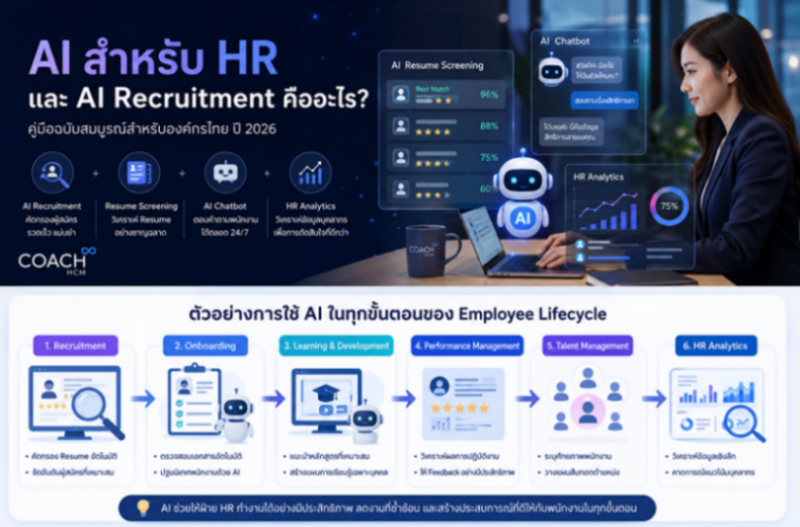
What is HR AI and AI Recruitment? The Beginning of Modern Workforce Management
In today’s highly competitive talent market, organizations are under increasing pressure to attract, engage, and retain top talent. As a result, the adoption of Artificial Intelligence (AI) in People Management and Recruitment has become a key driver of business competitiveness.
Traditionally, HR teams have been responsible for a wide range of tasks, including resume screening, candidate interviews, employee data management, report generation, and responding to employee inquiries. Many of these activities are repetitive, manual, and time-consuming, leaving HR professionals with less time to focus on strategic initiatives such as workforce planning, talent development, and enhancing the overall employee experience.
Today, AI is transforming the way HR teams operate. From identifying the most suitable candidates and analyzing workforce data to recommending personalized learning programs and predicting employee turnover, AI enables organizations to make faster, more accurate, and data-driven decisions rather than relying solely on human judgment and experience.
For organizations in Thailand, adopting AI in HR is no longer simply about embracing new technology. It represents a fundamental shift in workforce management—one that aligns with the demands of the digital workplace while supporting sustainable organizational growth.
Why Are More Thai Organizations Adopting AI in HR?
Over the past few years, Thai organizations have faced increasingly complex workforce challenges, including talent shortages, intense competition for top talent, evolving work models, and rapidly growing volumes of employee data. As workforce data continues to expand, HR teams must manage greater complexity while delivering faster and more informed decisions.
At the same time, executives and C-level leaders require accurate, real-time insights to support strategic decisions related to workforce planning, employee upskilling and reskilling, and talent retention. These demands have encouraged many organizations to leverage AI to automate routine tasks, improve analytical accuracy, and enhance decision-making.
Consequently, AI adoption is no longer limited to improving HR operational efficiency. It has become an integral part of organizations’ digital transformation strategies, enabling long-term competitive advantage.
What is HR AI?
HR AI (Artificial Intelligence for Human Resources) refers to the application of artificial intelligence technologies to support every stage of human resource management, from Talent Acquisition and employee data management to performance management, employee development, and People Analytics for executive decision-making.
One of AI’s greatest strengths lies in its ability to process vast amounts of data within seconds, continuously learn through Machine Learning, and generate actionable insights that enable HR teams to work more intelligently and efficiently.
However, the objective of AI is not to replace HR professionals. Instead, it is designed to automate repetitive and routine tasks, allowing HR teams to devote more time to high-value activities such as talent development, strategic workforce planning, and fostering a strong organizational culture.
How is AI Different from HRM or HCM Systems?
Many organizations assume that implementing an HRM (Human Resource Management) or HCM (Human Capital Management) system automatically means they are using AI. In reality, these technologies serve fundamentally different purposes.
HRM and HCM systems function as centralized platforms for managing employee information and HR processes, including employee records, time attendance, leave management, payroll, benefits administration, and performance evaluations.
AI, on the other hand, focuses on analyzing data, learning from patterns, and automating intelligent processes. Examples include resume screening, candidate evaluation, employee turnover prediction, and personalized learning recommendations based on individual skill gaps.
When AI is integrated with an HCM platform, organizations can transform large volumes of HR data into meaningful insights that support strategic workforce decisions.
Comparison: HRM/HCM vs. HR AI
Feature | HRM / HCM | HR AI |
|---|---|---|
| Primary Role | Centralized management of core HR data | Data analysis, learning, and intelligent recommendations |
| Operating Model | Rule-based workflows | AI-driven analysis and process automation |
| Data Analytics | Historical reporting (Descriptive Analytics) | Predictive Analytics and forecasting |
How Can AI Support HR Operations?
AI can enhance virtually every aspect of human resource management throughout the employee lifecycle—from recruitment and employee development to workforce planning and strategic analytics.
Common AI applications in HR include:
- Automatically analyzing and screening resumes
- Identifying candidates who best match job requirements
- Providing 24/7 employee support through AI chatbots
- Generating real-time workforce analytics and HR reports
- Recommending personalized learning programs based on skill gaps
- Evaluating employee performance and potential
- Predicting employee turnover risks
- Supporting strategic workforce planning
- Analyzing compensation trends and organizational structures
By automating repetitive tasks and improving analytical accuracy, AI enables HR professionals to focus on talent development and strategic business initiatives.
What Are the Limitations of AI?
Although AI offers significant benefits, organizations should recognize its limitations to ensure responsible and effective implementation.
Key considerations include:
- AI relies heavily on high-quality data. Poor data quality leads to inaccurate outcomes (Garbage In, Garbage Out).
- AI cannot fully replace human judgment, emotional intelligence, or contextual understanding required for complex HR decisions.
- Organizations must ensure compliance with PDPA and other data privacy regulations.
- AI systems should be governed to minimize the risk of algorithmic bias during recruitment and employee evaluations.
- AI-generated recommendations should always be reviewed by HR professionals before making decisions that affect employees.
Therefore, AI should be viewed as an intelligent assistant that enhances HR capabilities rather than replacing human decision-making.
How Does AI Support the Entire Employee Lifecycle?
AI extends far beyond recruitment. It supports organizations throughout every stage of the Employee Lifecycle, from attracting talent to developing employees, succession planning, and retaining high-potential individuals.
When integrated with an HCM platform, data from every stage of the employee lifecycle becomes interconnected. This enables AI to identify workforce trends, understand employee behaviors, anticipate future needs, and provide actionable insights for executive decision-making.
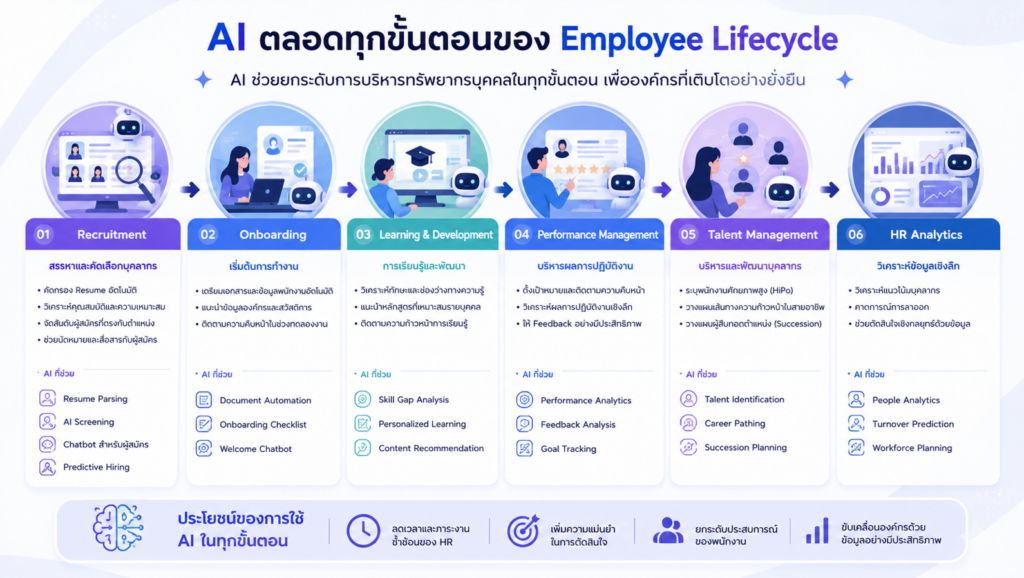
Employee Lifecycle AI
| Module | Description |
|---|---|
| Recruitment | Resume screening and candidate ranking |
| Onboarding | AI chatbot for new employee assistance |
| Core HR | Workforce analytics and intelligent alerts |
| Performance | Performance analysis and personalized development recommendations |
| Learning | Learning recommendations based on skill gaps |
| Succession | Talent assessment and succession planning |
| Retention | Employee turnover risk prediction |
What is AI Recruitment?
AI Recruitment is the application of Artificial Intelligence (AI) to the recruitment and Talent Acquisition process. It enables organizations to identify, assess, and select candidates who best match both the job requirements and the organization’s culture more quickly while reducing potential hiring bias.
Traditionally, recruitment involved manually reviewing resumes one by one, scheduling interviews, and following up with candidates throughout the hiring process. These activities required significant time and resources. Today, AI helps automate repetitive tasks while analyzing candidate data from multiple perspectives—including work experience, skills, expertise, and job fit—allowing HR professionals to focus more on qualitative assessments and final hiring decisions.
Beyond reducing time-to-hire, AI Recruitment also enhances the Candidate Experience by providing automated responses, real-time application status updates, and faster communication throughout the recruitment journey. As a result, organizations can strengthen their employer brand, deliver a better candidate experience, and attract high-quality talent more effectively.
How Does AI Recruitment Work?
AI Recruitment integrates with an Applicant Tracking System (ATS) or a Human Capital Management (HCM) platform to analyze candidate data and automate key stages of the recruitment process. It supports HR teams throughout the entire hiring journey—from posting job openings to shortlisting candidates for interviews.
A typical AI Recruitment workflow is as follows:
Job Posting
↓
Resume Collection from Multiple Channels
↓
Resume Parsing
↓
AI Resume Screening
↓
Candidate Ranking
↓
Interview
↓
Offer
At every stage of the recruitment process, AI helps reduce the administrative workload for HR teams. It can automatically extract information from resumes, screen candidates based on predefined qualifications, rank applicants according to their suitability for the role, and notify candidates of their application status. As a result, organizations can streamline recruitment, improve transparency, reduce manual errors, and create a more efficient hiring process.
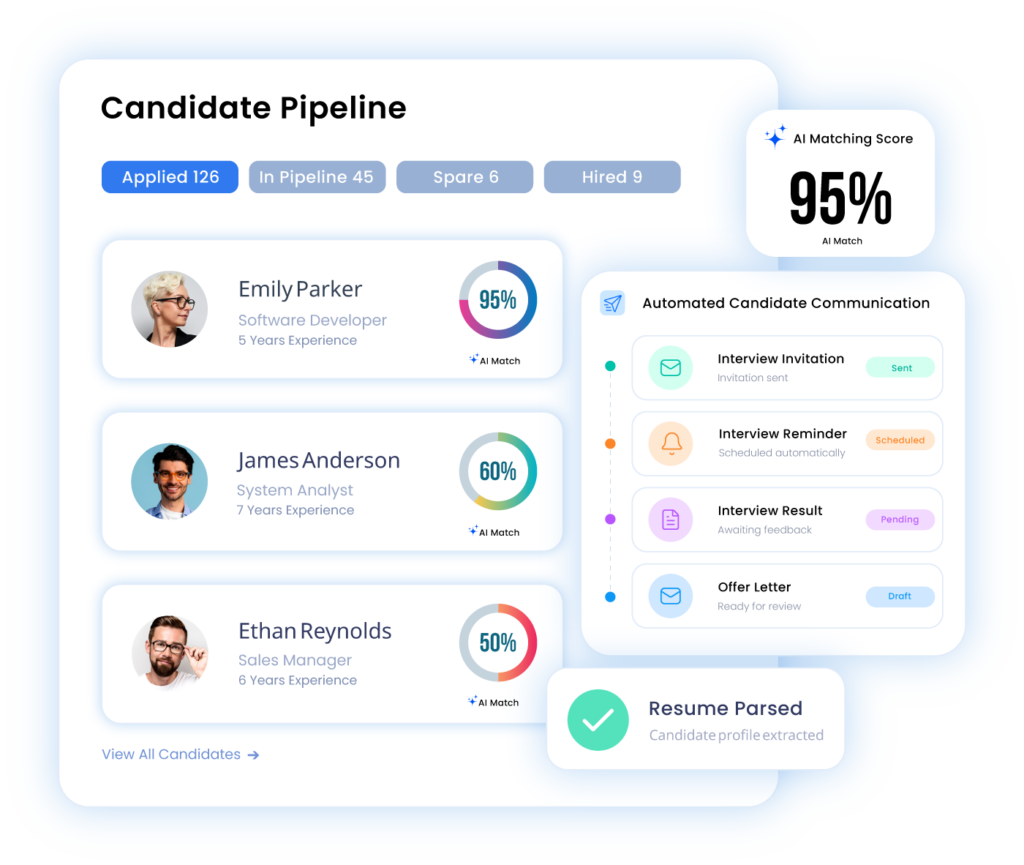
What is AI Resume Screening?
AI Resume Screening is the use of Artificial Intelligence to automatically analyze and screen candidate resumes to evaluate how well applicants match the requirements of a specific job position.
Instead of requiring HR professionals to manually review hundreds or even thousands of resumes, AI compares candidate information against predefined hiring criteria, such as educational background, work experience, technical skills, professional certifications, and job-related keywords. Based on this analysis, AI ranks candidates according to their suitability for the role.
However, AI Resume Screening should be used as an initial screening tool rather than a final decision-maker. Evaluating factors such as personality, attitude, communication style, and cultural fit still requires human judgment from HR professionals and hiring managers.
What is Resume Parsing?
Resume Parsing is an AI-powered technology that automatically reads, analyzes, and extracts information from resumes or Curriculum Vitae (CVs), converting unstructured documents into standardized, searchable data without requiring manual data entry by HR personnel.
AI can automatically extract key information, including:
- Candidate name and contact information
- Educational background
- Work experience
- Skills
- Languages
- Certifications and professional qualifications
- Areas of expertise
Once the information has been standardized, organizations can quickly search, compare, and analyze candidate profiles. Resume Parsing also minimizes manual data entry errors while creating a searchable talent database that can be reused for future recruitment needs.
What is AI Interview?
AI Interview refers to the application of Artificial Intelligence to support various stages of the interview process, from interview scheduling and initial candidate screening to interview analysis that helps HR professionals and hiring managers evaluate candidates more effectively.
Common AI Interview applications include:
- Automatic interview scheduling
- Sending interview invitations and reminders via email or messaging platforms
- Conducting initial interviews through AI chatbots or video interview platforms
- Generating interview transcripts automatically
- Summarizing key discussion points and producing interview reports
Despite these capabilities, evaluating candidates’ personality, communication skills, problem-solving abilities, and cultural fit should remain the responsibility of HR professionals and hiring managers to ensure well-rounded hiring decisions.
AI Chatbots for Recruitment
An AI Recruitment Chatbot is an intelligent virtual assistant that communicates with candidates throughout the recruitment process. It can answer questions, provide job-related information, schedule interviews, and update candidates on their application status automatically, 24 hours a day, seven days a week.
Common use cases include:
- Answering questions about job openings and candidate qualifications
- Recommending suitable positions based on candidates’ skills and experience
- Collecting preliminary applicant information
- Scheduling interviews automatically
- Providing real-time application status updates
- Responding to frequently asked questions (FAQs) about the recruitment process
By implementing AI chatbots, organizations can respond to candidates more quickly, reduce administrative workloads for HR teams, and deliver an exceptional candidate experience from the very beginning of the hiring journey. This also strengthens employer branding and increases the organization’s ability to attract top talent.
Benefits of HR AI and AI Recruitment
HR AI and AI Recruitment enable organizations to manage their workforce more efficiently—from talent acquisition and employee development to workforce analytics and strategic decision-making.
Reduce Time-to-Hire
AI automatically screens resumes, evaluates candidate qualifications, and ranks applicants according to job requirements, significantly accelerating the recruitment process and shortening hiring cycles.
Improve Hiring Accuracy
By analyzing multiple candidate attributes simultaneously, AI provides HR professionals with more comprehensive insights, enabling better-informed hiring decisions and improving the quality of new hires.
Reduce Administrative Work
AI automates repetitive HR tasks such as answering inquiries, screening resumes, generating reports, and tracking candidate progress, allowing HR teams to focus on strategic initiatives.
Enhance Candidate and Employee Experience
AI chatbots and workflow automation provide fast, convenient, and continuous support for both candidates and employees, creating a seamless experience throughout the employee lifecycle.
Enable Data-Driven Decision Making
AI analyzes workforce data and generates actionable insights that support workforce planning, employee development, and strategic HR decision-making.
Examples of AI Applications in HR
AI is no longer limited to recruitment. It can enhance every stage of human resource management by improving efficiency, reducing administrative workloads, and enabling data-driven decisions.
AI Recruitment & Resume Screening
AI screens resumes, evaluates candidate qualifications, and ranks applicants according to job fit, helping organizations reduce hiring time while improving recruitment accuracy.
AI Chatbots for HR Services
AI chatbots provide instant responses to employee inquiries regarding leave requests, benefits, payroll, company policies, and other HR-related topics, improving employee experience while reducing HR administrative tasks.
AI Learning & Personalized Training
AI identifies individual skill gaps and recommends personalized learning paths and training programs that help employees develop the competencies most relevant to their roles.
AI Performance & Talent Analytics
AI analyzes employee performance, competencies, and potential to support succession planning, talent management, and long-term workforce development.
AI Workforce Analytics
AI collects and analyzes workforce data—including employee turnover, hiring trends, labor costs, and organizational performance—to provide valuable insights that support strategic workforce planning and Data-Driven HR initiatives.
Future Trends in HR AI
Artificial Intelligence continues to evolve rapidly and is transforming the role of HR from a process-oriented function into a strategic business partner.
In the coming years, organizations can expect broader AI adoption across HR, including the use of Generative AI for document creation, AI Agents for workflow automation, and advanced People Analytics to predict workforce trends and support proactive decision-making.
For organizations seeking sustainable competitive advantage, success will depend on building a strong data foundation, implementing a centralized Human Capital Management (HCM) platform, and combining AI-powered insights with expert human judgment. Together, these capabilities will enable organizations to modernize workforce management, improve business agility, and support long-term organizational growth.
Read Related Articles : AI-Powered HR with AIRA Transform HR with the Power of AI
Conclusion: HR AI Is the Key to Workforce Management in the Digital Era
Implementing HR AI and AI Recruitment is more than simply adopting new technology—it is about transforming human resource management to become more efficient, agile, and data-driven.
From talent acquisition and candidate selection to resume analysis, employee support through AI chatbots, personalized learning recommendations, workforce analytics, and employee turnover prediction, AI helps automate repetitive tasks, improve decision-making accuracy, and enable HR professionals to focus on higher-value strategic initiatives.
However, maximizing the value of AI is not solely about choosing the most advanced AI solution. Success depends on having a robust Human Capital Management (HCM) platform that serves as the organization’s Single Source of Truth. With centralized, accurate, and reliable workforce data, AI can generate meaningful insights that align with the organization’s unique business context, empowering HR leaders to make smarter, more informed decisions.
คำถามที่พบบ่อย (FAQ)
1. What is HR AI?
HR AI (Artificial Intelligence for Human Resources) refers to the application of artificial intelligence to support various human resource management functions, including recruitment, resume screening, workforce analytics, performance management, employee development, and HR reporting. By automating and enhancing these processes, AI enables HR teams to work more efficiently, accurately, and strategically.
2. How is AI Recruitment different from traditional recruitment?
Traditional recruitment typically relies on manual resume screening, which can be time-consuming and subject to human bias. In contrast, AI Recruitment can analyze large volumes of candidate data within seconds, rank applicants based on predefined qualifications, assess job fit, and automate repetitive recruitment tasks. This results in a faster, more efficient, and data-driven hiring process.
3. What is Resume Parsing?
Resume Parsing is an AI-powered technology that automatically reads and extracts information from resumes or CVs, such as candidate names, educational background, work experience, skills, and certifications. The extracted data is then converted into a structured format that can be easily searched, analyzed, and compared, reducing manual data entry while improving recruitment efficiency.
4. Can AI replace HR professionals in recruitment?
No. AI can effectively analyze and screen candidates during the initial stages of recruitment, but it cannot fully replace HR professionals. Critical hiring decisions involving personality, attitude, cultural fit, and long-term potential still require human judgment, experience, and collaboration between HR professionals and hiring managers.
5. What are the benefits of an AI Chatbot for HR?
An AI HR Chatbot can provide 24/7 responses to frequently asked employee questions, including leave policies, employee benefits, payroll information, public holidays, HR procedures, and company policies. This helps reduce the administrative workload of HR teams while providing employees with faster and more convenient access to information.
6. Is HR AI suitable for small businesses?
Yes. HR AI is suitable for organizations of all sizes, including small, medium-sized, and large enterprises. Businesses can begin by implementing AI for repetitive tasks such as resume screening, employee support, or HR reporting, and gradually expand its use to workforce analytics, talent management, and strategic workforce planning.
7. What should organizations consider before implementing AI in HR?
Organizations should prioritize data quality, personal data security, and compliance with relevant regulations such as the Personal Data Protection Act (PDPA). Additionally, AI-generated recommendations should be reviewed regularly to minimize potential algorithmic bias and ensure fair, transparent HR decision-making.
8. How can AI analyze employee data?
AI can analyze a wide range of workforce data, including employee turnover trends, absenteeism rates, performance metrics, learning and development needs, organizational skill gaps, and recruitment effectiveness. These insights enable HR leaders and executives to make more informed, data-driven workforce decisions.
9. Will AI replace HR professionals?
No. AI is designed to augment—not replace—HR professionals. By automating repetitive and time-consuming tasks, AI allows HR teams to focus on strategic responsibilities such as talent development, employee experience, organizational culture, and business growth.
10. How can organizations get started with HR AI?
Organizations should begin by identifying HR processes that are repetitive, time-consuming, or data-intensive, such as recruitment, employee support, or HR reporting. The next step is to implement an HCM (Human Capital Management) platform that supports AI integration, enabling intelligent automation and workforce analytics. Starting with small-scale AI initiatives and gradually expanding adoption allows organizations to achieve measurable results while ensuring a smooth digital transformation.
 Interested in COACH HCM?