
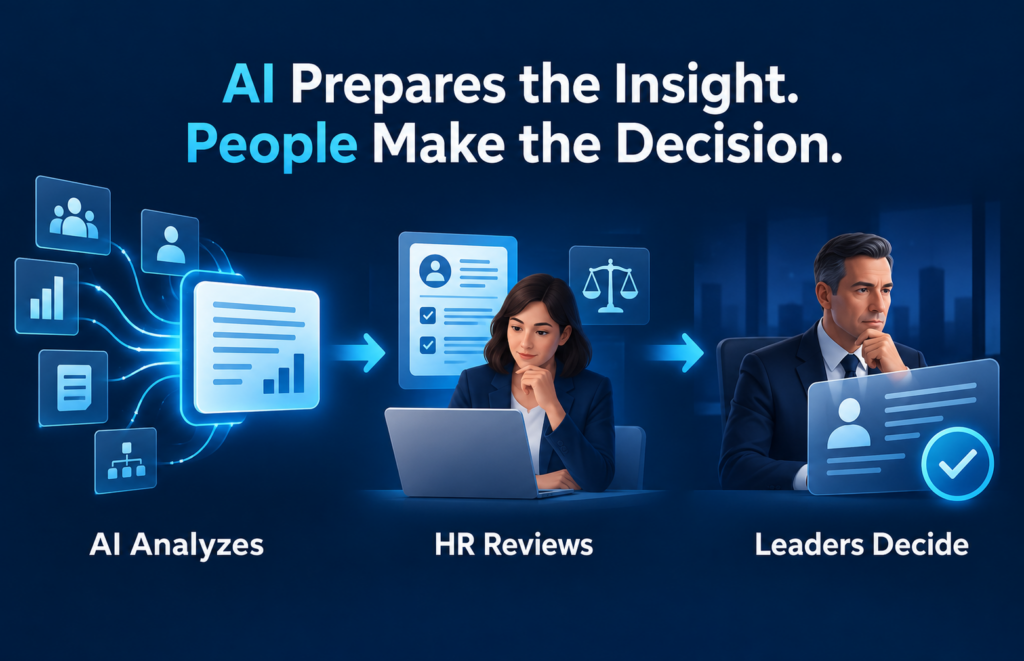
HR Trends 2027 will not be defined by whether an organization has adopted AI. The real difference will be its ability to redesign work so that people and AI can operate together effectively. AI can retrieve information, summarize data, identify patterns, create drafts, and suggest options. HR professionals and executives must still remain accountable for context, fairness, employee impact, and final decisions.
For organizations in Thailand, the priority is not replacing people with technology. It is turning AI into a practical assistant that works with reliable HR data, appropriate access controls, human review, and clear governance.
From AI Tool to AI Assistant: How HR Work Is Changing
Many organizations first adopted Generative AI as a stand-alone tool for tasks such as drafting job advertisements, summarizing documents, or improving emails. By 2027, the focus will shift toward AI Assistants that connect with approved workflows and data sources, helping users complete several related steps more efficiently.
This shift does not mean that AI should make employment decisions. For example, AI may categorize resumes against defined criteria, but HR must evaluate whether those criteria are appropriate, consider the wider context, and remain responsible for the decision.
Research published by the International Labour Organization in 2025 supports this distinction. Although many occupations are exposed to Generative AI, most jobs are more likely to be transformed than eliminated because human input and judgment remain necessary.
| AI can assist with | HR and executives remain responsible for |
|---|---|
| Retrieving and summarizing authorized information | Verifying accuracy and context |
| Drafting job descriptions, feedback, or development plans | Adapting the content to the actual role and individual |
| Grouping data and highlighting anomalies | Investigating causes and deciding what action to take |
| Suggesting questions or alternative options | Evaluating impact, fairness, and risk |
| Preparing initial reports or insights | Connecting findings to strategy and owning the conclusion |
7 HR Trends for 2027
1. AI Will Become Part of the Workflow, Not Just a Chat Window
AI creates more value when it appears at the right point in a real process. It may help review candidate information within a Candidate Pipeline, draft a performance summary, or retrieve answers from approved organizational knowledge.
Organizations should start with process mapping. Identify activities that consume significant time, involve repetitive work, or require data to move through several handoffs. AI should be introduced only where it provides a clear benefit without creating disproportionate risk.
2. HR Analytics Will Move from Viewing Reports to Asking Questions
Dashboards will remain important, but users will increasingly expect to ask questions directly. Executives may want to know which business units show a changing turnover pattern or which workforce indicators require further investigation. AI can help summarize patterns and prioritize issues for review.
However, correlation does not automatically prove causation. Leaders should verify data quality, metric definitions, and business context before drawing conclusions or making workforce decisions.
3. Recruitment Will Become Faster, but Human Oversight Will Matter More
AI can support Resume Parsing, screening against defined requirements, and Candidate Matching. These capabilities can help recruitment teams manage large candidate volumes more systematically, but speed should not come at the expense of transparency or fairness.
HR should understand which criteria are being used, check whether irrelevant information influences the result, and ensure that a person can review or override the recommendation. A named decision owner should remain accountable for hiring outcomes rather than transferring responsibility to an automated score.
4. Performance Management Will Focus on Feedback Quality
AI can help draft feedback or summarize performance information. A polished paragraph, however, is not evidence that the assessment is accurate or fair. Managers still need to validate real events, explain expectations, and create space for discussion with employees.
A practical approach is to let AI organize evidence, strengths, gaps, and possible next steps. Managers should then revise the output before sharing it. The process should connect with KPI or OKR goals, Competency frameworks, and development plans rather than producing generic comments for every employee.
5. Reskilling Will Become a Workforce Strategy
As AI changes specific tasks within jobs, organizations need to look beyond job titles. They should identify which tasks and skills are changing in each role. The World Economic Forum’s Future of Jobs Report 2025 reinforces the importance of workforce skills and transition planning toward 2030.
HR should connect Competency data, performance results, and Individual Development Plans (IDPs) to prioritize upskilling and reskilling. Success should be measured by how employees apply new skills at work, not only by the number of training hours completed.
6. AI Governance Will Require HR, IT, Legal, and Executive Ownership
Employee data may include personal information, employment history, performance records, and potentially sensitive information. Using that data with AI requires clear purposes, appropriate access, retention rules, and named accountability.
At a minimum, organizations should be able to answer these questions:
- What data does the AI use, and is each data element necessary for the purpose?
- Who can access the input, output, and usage history?
- Which information must never be entered into public AI tools?
- Where is Human Review required before an output can be used?
- How can an employee or candidate question or challenge a result?
- How will the organization periodically test for errors, bias, and abnormal outcomes?
The NIST AI Risk Management Framework can provide useful risk-management concepts, but it is not Thai law. The treatment of employee data should be reviewed by the organization’s legal or PDPA specialists based on the actual purpose and facts.
7. Executives Will Need AI Literacy, Not Just AI Tools
Executives do not need to build AI models, but they should know what questions to ask. What is the source of the data? What are the limitations of the output? Who is accountable? Do success measures reflect business outcomes, or merely the volume of content produced?
AI literacy for leaders includes critical interpretation, data protection, accountability, and change management. Treating every AI output as a fact may accelerate risk as quickly as it accelerates work.
A 90-Day Roadmap for Introducing AI into HR
H3 : Days 1-30: Choose the Problem and Establish the Data Foundation
- Collect possible use cases from HR and business leaders.
- Score each use case by value, data readiness, and risk.
- Select one or two pilots with clear Human Review, such as drafting job descriptions or summarizing reports.
- Identify the data owner, access rights, and prohibited data.
- Establish a baseline such as time spent, number of revisions, error rate, or quality before the pilot.
Days 31-60: Run a Controlled Pilot
- Define the user group and usage guidelines.
- Test both normal scenarios and higher-risk cases.
- Record errors, hallucinations, potential bias, and user feedback.
- Require a responsible person to review every output before operational use.
- Review privacy, access, and logging arrangements.
Days 61-90: Measure Results and Decide Whether to Scale
- Compare the pilot results with the baseline.
- Measure speed, quality, consistency, error rates, and user confidence.
- Improve the workflow and Human Review criteria.
- Scale only the use cases that provide value while keeping risk under control.
- Build an upskilling plan and a recurring governance review.
Checklist for Selecting AI for HR in 2027
- Start with a real work problem, not with the word AI.
- Identify data sources and define how the data may be used.
- Apply appropriate access controls and usage monitoring.
- Allow people to review, edit, or reject AI recommendations.
- Do not accept claims of perfect accuracy or use AI scores as final decisions.
- Connect the AI use case with relevant HR processes within the agreed project scope.
- Assign a use-case owner who is accountable for the outcome.
- Measure agreed indicators before and after implementation.
- Prepare communication and skill development for HR, managers, and employees.
- Involve IT, Security, Legal or PDPA specialists, and business owners according to the level of risk.
How COACH HCM and AIRA Can Support Human-AI Collaboration
COACH HCM connects HRM, Payroll, Recruitment, HRD, and Analytics processes within one environment. AIRA supports AI-assisted workflow concepts such as resume screening and candidate matching, performance summaries, drafting feedback and job descriptions, Individual Development Plan recommendations, and assistance with HR report analysis, subject to the available feature and implementation scope.
AI should prepare information and suggest options rather than make autonomous employment decisions. Organizations should confirm the exact feature, integration, access-control, and implementation requirements with the product team before use.
Frequently Asked Questions About HR Trends 2027
Will AI replace HR professionals in 2027?
AI is more likely to transform specific tasks within HR roles than replace the entire HR function. Information retrieval, summarization, categorization, and drafting may become faster, but decisions affecting employees still require context, human oversight, and clear accountability.
Which HR tasks are suitable for an initial AI pilot?
Start with tasks that use reliable data, involve manageable risk, and produce reviewable outputs. Suitable examples include drafting job descriptions, summarizing reports, retrieving approved internal knowledge, and structuring feedback. Organizations should avoid beginning with autonomous hiring, termination, or performance-rating decisions.
What is the difference between an AI Assistant and an AI Agent?
An AI Assistant supports users by completing tasks or providing information in response to instructions. An AI Agent can plan and execute several steps with greater autonomy. The more independently an AI system operates, the stronger its access controls, approval requirements, human review, and monitoring should be.
How should executives use AI with HR Analytics?
AI can help identify patterns, summarize trends, and highlight areas that require further investigation. Executives should still verify metric definitions, data quality, and business context before reaching conclusions because correlation does not necessarily prove causation.
What should organizations consider when using AI with employee data?
Organizations should review the purpose and necessity of the data, access rights, transfers to service providers, retention arrangements, and channels for exercising data-subject rights. They should also define which information must not be entered into public AI tools and consult their legal or PDPA specialists based on the actual use case.
How can an organization measure the ROI of AI in HR?
Establish a baseline before launching a pilot. Measure time, work quality, revision cycles, error rates, user adoption, and process outcomes. The number of messages, reports, or documents generated by AI should not be the only measure of success.
Where should an organization start if its HR data is fragmented?
Begin by assigning data ownership, establishing common definitions, and identifying trusted data sources. If the source data is incomplete, duplicated, or inconsistently defined, AI may generate answers quickly without making them more reliable.
Does COACH HCM or AIRA use AI to make decisions instead of HR?
AIRA is intended to assist HR through analysis, summaries, drafting, and recommendations within the available features and agreed implementation scope. HR professionals, executives, and designated decision owners should continue to review the results and remain accountable for employment decisions.